Human & Atomic Interactions

I want to pause a moment in between my Memoirs series, its last blog-post The Party and its continuation The Poke-her Game because I have recently been very inspired to write this post. For my BDSM readers, I apologize — it’s almost finished so thank you in advance for your patience. Now to the fascination of Human and Atomic Interactions.

≤ ≤ ≤ ≤ · ≅ · ≥ ≥ ≥ ≥
(line break)

Are you familiar with some terms in chemistry? Many? How about covalent compounds, polar covalent compounds, ionic bonds, electronegativity, and electropositivity? These are a few terms that define the interactions between atoms. Is it any surprise we can draw parallels between atomic interactions and human interactions? It’s not difficult. After all, every single one of us are made up of bonds, compounds, and atoms in ever so slightly varied formations. I’d like to share the chemical definitions of the terms mentioned above according to Chemistry-Dictionary.com:

Covalent bonds — 1) chemical bond formed by the sharing of one or more electron pairs between two atoms. 2) atoms linked together by sharing valence electrons.

Polar covalent bonds — 1) covalent bond in which there is an unsymmetrical distribution of electron density. 2) atomic linkage with both ionic and covalent characteristics.

Ionic bonds — atoms linked together by the attraction of unlike charges.

Electronegativity — 1) a measure of the relative tendency of an atom to attract electrons to itself when chemically combined with another atom. 2) a measure of the ability of an atom in a molecule to draw bonding electrons to itself. This is partially determined by how many electron vacancies are available in an element’s filling orbital. The most electronegative elements are the halogens, which have only one vacancy (i.e. have seven electrons in their filling orbital). Sulfur and oxygen are also highly electronegative. 3) a number describing the attraction of an element for electrons in a chemical bond.

Electropositivity — a measure of an element’s ability to donate electrons, and therefore form positive ions; thus, it is opposed to electronegativity. (Wikipedia)

Notice how the exchange or resistance, the charge and intensity of electrons make up much of the interactions between these five chemical states? Would it be beneficial to find applications of these chemical states in everyday life to gain more meaning and purpose? Is it good to understand how things interact, what makes strong or weak bonds and why they react the way they react to each other? I certainly want to understand (and respect!) why ammonia-nitrate does not react well with specific other compounds. Or why nitroglycerin does not react well inside playroom hippity-hop balls or attached to pogo-sticks!
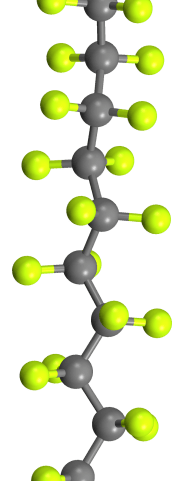
perfluorodecyl-chain

Teflon molecule

I feel it is also equally important to know and understand good helpful bonds and reactions. How many of you are aware of polytetrafluoroethylene and what it helps and prevents? While building the tallest bridge in the world, in southern France, the Millau Viaduct faced some unprecedented engineering obstacles. In the bridging-phase between the seven enormous masts, engineers needed a method of scooting the eight 8,070-ft long, 36,000 ton decks from one mast to the next 890-feet up. It was accomplished by using two huge polytetrafluoroethylene-coated hydrolic-powered opposed wedges in a, albeit only 600-millimeters per cycle,  leap-frog motion. Today, the bridge allows traffic to pass quicker between Paris and Montpellier with no apparent ecological impact to the area.

How about the critical bonds of hydrogen or peptides? How much are these two bonds used? The fact that all humans consist of roughly 63% body fluid, hydrogen bonds are vital to body functions. Peptide bonds are just as vital. All proteins, DNA, RNA, as well as multitudes of other structures use this bond. EMT’s and ER doctors and nurses must be thoroughly trained in these chemical makeups and interactions in order to save and/or rehabilitate patients. It certainly doesn’t hurt non-medical persons to have very basic understandings of these bonds for everyday life.

In my Earth or Physical Science classes we’d often discuss and learn about “Happy Atoms.” Like any of us, most atoms want to be alive and happy. The concept can be summarized this way:  if your atomic shell (mind, body, soul) was full, then you are a Happy Atom. There are atoms (people) with extra electrons. They enjoy giving up or donating their electrons. Other atoms (people) have almost-full shells. They move around seeking out atoms (people) who have extra to give. Prime examples of these interactions are sodium with magnesium, and oxygen with fluorine. When they work together with their electrons, both pairs and multiple pairings can end up happy. Like magnets the positive and negative charges of electrons attract each other. This is when “opposites attract” to form a strong bond. However, as is often the case in many aspects of chemical and life-interactions, not all are “happy bonds.” Why unhappy?

unhappy-coupleUnhappy bonds can be described as those possessing low, medium, or high energy levels. Taking this description a bit further, managing the increase or decrease of these energy levels can be directly associated with a knowledge-interaction bank, if you will. This bank knows what investments and withdrawals are dangerous and risky, as well as those that are profitable and safe. But there is one and only one factor that the bank cannot inerrantly predict:  How well does each individual customer thoroughly understand their own molecular makeup, their behavior blueprints, or how well or poorly to articulate them. You see, it isn’t enough to understand or attempt to understand only external interactions and dynamics. You, yourself, are just as important as any others in the interactions. How well and how honestly you understand yourself, often… no, equally determines what type of interactions you and others create.

Sir Francis Bacon once said that “knowledge is power.” Power for what? Clearly there are positive life-giving interactions between molecules and organisms, and there are negative ones. These interactions, all of them, and please excuse the intentional dichotomy, are they necessarily unnecessary? Is the knowledge-interaction bank exclusive only to the student? To the teacher? To the classroom of classmates? To one school? And here is perhaps a bigger question:

Is there a necessary or unnecessary learning-curve to understanding life’s interactions?
(line break)

We interrupt this program to bring you an important musical and meme message!

atoms-feelings-truth

In the fields of neurology, pathology, endocrinology, genetics, linguistics, psychology, sociology, even philosophy — is there an interdisciplinary term for these(?) — do these areas perpetually interact or are they completely self-sufficient, self-reliant?

With chemical interactions, many if not most are well understood and predictable, until we humans or the environment create new ones. With human interactions, some… if not more or less… are well understood, until someone or others invent new ones. When these unexpected creations occur, and they inevitably do, how should they be received? Received with instantaneous conclusions or judgements, or with reservation, patience, and time in order to account for margins of error? Perhaps with elements of both? Is there a time to speak your results or a time to quietly wait, to consider, and reconsider? It has been my personal experience that TIME… typically more than what I first imagine, is the wise policy. A policy to suspend or allow for the learning-curve, if for no other reason than to remind myself that in order to gain improved interactions, human or otherwise, this policy also allows for the greatest of virtues and bonds to flourish.

To my readers and followers, what are your thoughts and experiences with interactions and bonds… atomic, chemical, or human? Please share them!

Live Well — Love Much — Laugh Often — Learn Always

(paragraph break)

Creative Commons License
This work by Professor Taboo is licensed under a Creative Commons Attribution-NonCommercial-NoDerivatives 4.0 International License.
Permissions beyond the scope of this license may be available at www.professortaboo.com/contact-me/.

Larger Little Gifts

I should be posting my final part to my Untapped Worlds series because it is three-quarters finished. But to me this quick post takes more precedence.

* * * * * * * * * *

There’s a cliché, an adage that says “Don’t look a gift horse in the mouth.” Life has firmly taught me that this cliché is not a very wise outlook. In fact, the better outlook is “Damn well better look in the horses’ mouth! In fact, take it to the nearest orthodontist and get full x-rays and cleanings because some or many of those teeth and gums could be wooden, abscessed, and outright dentures or implants! While at it take it to the best veterinarian too!” Hah!

And then there are those rare moments like I had late last night when the one thing I THOUGHT wouldn’t couldn’t happen, happened. Actually it was two Larger Little Gifts.

The first gift was a voicemail from a job position I had applied for many weeks ago with the local VA in association with the state hospital. I am extremely qualified for this Nurses Assistant opening AND have all the necessary background to be superb at it. In fact, I’m overqualified given my background and work-experience. The REAL position I want is helping families of veterans with PTSD and other psychological issues and their dynamics within families of returned, wounded or otherwise, veterans. I am just a semester or two away from completing my Masters degree from 1991 in psychology, addiction, and counseling/therapy. This is all that stands in the way of an approved state license and better pay (relatively speaking) than continuing as a Special Ed teacher in Texas. This voicemail made me jump up and down pumping my fist hard as if I just saved a shot to the upper-90 in the dying injury/extra minutes of the World Cup Final to preserve our win! I’m not sure even that fully describes my elation. If I get an actual face-to-face interview(?), I am SO in. 😀

Laughing coupleThe second but easily the larger little gift was from a long-time online-dating interest who I had thought wasn’t real. In fact, many profiles on most all ‘dating sites’ are fake; fake pictures, no pictures at all, short cookie-cutter self-descriptions and their “criteria” for a dream partner/spouse. Then there are the marketing methods to keep you on the website without actually ever talking live or meeting anyone, i.e. contact-info-forbidden instructions and restrictions. This method gets more money out of you. If someone does chat with you, many fake profiles try to bait-you over to their website they’ve been paid a fee to ‘recruit’ you away. The 5-6 dating-sites I’ve been a past member, these business and ‘member’ practices are to be expected — afterall, “love” is a multi-million dollar growing business. Cha-ching!

But this one woman’s profile was different, very different. Yes she had some 5-7 very recent photos AND unique clever descriptions I’ve never read in my 13-years of online-dating sites! She was extraordinary! No, check that; my first impression was “way too good to be true.” Wow, was I wrong.

When she eventually responded to my interests and my introductory email, I knew instantly by the way she wrote… “This was a winner.” After only 4-5 HILARIOUS email exchanges thru the site… we were both begging each other to get on the phone together. When we did, after only 5-10 minutes I knew instantly in my 36-years of dating, relationships, and two marriages/divorces… this one is like no other, hands down.

We talked EASILY near 3-hours as if we’d come from the same families, areas, travels, and values. Damn near identical. She wanted to know much more about me and I her. She got it; everything, no holes barred from me because she was sick-n-tired of the artificial B.S. on many dating websites — hit repeat. Twice she told me to lay it on, all of it, and followed with ‘dear God this is so refreshing!‘ We both laughed knowing we both understood; like identical twins we got it. We’ve both lived it so long. No full locked-up closets between us! She cleaned house on me! It was SPECTACULAR! I was so freaking giddy last night I couldn’t sleep fast enough to shoot a little text-message this morning how much I thoroughly enjoyed our too brief 3-hour talk! HAH! I wasn’t quick enough!

At 7:40am I get a text-message from her. Want to know what she told me?

Bwahahaha! Right. It’s none of your business! But stay tuned if you like. This journey/story is guaranteed to be a great ride!

Score a point for the VA. Ding. Score game-winner for serendipitous surprises! 🙂

Live Well — Love Much — Laugh Often — Learn Always

(paragraph break)

Creative Commons License
Blog content with this logo by Professor Taboo is licensed under a Creative Commons Attribution-NonCommercial 4.0 International License.
Permissions beyond the scope of this license may be available at https://professortaboo.com/.

Blind Value

(paragraph break)
In every adversity lies the seed of an equal or greater opportunity.
– Napoleon Hill

(paragraph break)

I had my ego handed to me on a skewer recently and soon politely stitched back together by some wonderful ladies. Though it was sometimes grimacing to read, hear, and own, getting rightly challenged is always a good life-lesson. Two worthy friendly intuitives were Victoria of Victoria NeuroNotes, and Ruth of Out From Under the Umbrella. Please take a few minutes to hop over and browse their excellent and provactive blogs.

(paragraph break)

* * * * * * * * * *

The discussion and padded verbal wrestling was over a critical, rampant social problem that must be addressed and improved. What is the social problem you ask? Blatant and subtle sexism in our cultures.

A number of people shy away from controversial issues; disagreeing can be exhausting, no doubt. Many times we allow our natural emotional defenses to bow-up because let’s face it, being shaken or jolted from your comfort zone is not often thrilling. Yet, in contrast, would permanent stagnation be the best disposition in a world constantly morphing and changing with people morphing and changing to adapt, survive, and succeed? Not to me. For me stagnation is smelly-risky, and intellectually and spiritually monotonous. Luckily, utilizing weighted physical, mental, and emotional workouts makes us stronger and wiser. Unfortunately, in zero-gravity the human mind, body, and heart weakens and becomes feeble!

Voluntary Blindness

There is a term and practice in one of my alternative lifestyles called sensory deprivation. It is sometimes called perceptual isolation. Though in my mind there are correlations between pin-the-tail-on-the-donkey or hide-n-seek, with sensory deprivation used in S.S.C. BDSM, this post is not about the lifestyle; so bear with me a minute while I elaborate.

Basically, sensory deprivation is the deliberate reduction or removal of stimuli from one or more of the senses. Simple devices such as blindfolds or hoods and earmuffs can cut-off sight and hearing respectively, while more complex devices can also cut-off the sense of smell, touch, taste, thermoception (heat-sense), and ‘gravity’. Sensory deprivation has been used in various alternative medicines, as well as in psychological experiments (e.g., Google isolation tank).

BlindnessLike it or not, sensory deprivation has tremendous human benefits! A big one has nothing to do with my alternative lifestyle and yet it is actually promoted, albeit indirectly, in several therapeutic fields and practices. Most knowledgeable people already recognize that when one of the five human senses is non-functioning, the other four and the brain try to compensate. The compensation by the vigorous working senses are typically proportional in counterbalancing the lost sense or senses. Occasionally that compensation goes beyond normal expectations and so offers an otherwise new unknown level of stimulus. The human body’s adaptability from crisis is an astonishing kinetic work of art or horror when it has (or doesn’t have) the proper time to adjust, create, or regenerate! Here is a question to consider…

Is sensory compensation much different in common daily social interaction, private or public?

Into the Wrestling Rink!

When I took my bumps and bruises from Ruth’s two blog-posts and comments, and Victoria’s triggered exception about my inappropriate (private and public) sexist comment to her, I got a sand-paper lesson in flirting etiquette! And no matter how much I attempted to prove my intended fictitious jesting and poking, I couldn’t change what had been written under the influence of… animated egomania. My emergency iodine applications turned out to be (ugh!) industrial-grade salt in her eyes and opened wound. What I needed was deflation. I NEEDED AND DESERVED MY REPRIMAND.

Listen men, more specifically heterosexual men, there is a clear and undeniable line, verbally and non-verbally, that you/we are NOT supposed to cross or violate. Period. But wait, there’s more! Even if she initially hints or invites the crossing of a cloudy grey-line, you are still completely responsible for everything you say or do in response as long as you both are alive, or Stage 3 Alzheimer’s sets in. 😉 Humor aside, do we grasp the full breath of what that means!? We cannot go back in time and change words and actions — human time-travel may NEVER be discovered — so it should go without saying! But hello, it needs repeating and it needs reinforced teaching until stuck and sticks permanently…

Consider and choose your words and actions very precisely.

In fact, become a Master and Gentleman of Impeccable Etiquette — start now! Sorry, we will never have the perpetual Get Out of Jail Free card.

In hindsight, I broke one of my/our cardinal rules in the lifestyle and didn’t even realize it until Victoria then Ruth called me on it. My nature, personality, and lifestyle-mantra of 25+ years has been/is to be acutely aware and in-tune with my woman’s present and future condition. To a different extent that is also true to female friends, and I effed it up.

To be a principled advocate and model of my lifestyles publicly, the last people I need to harm are polite innocent outsiders or guests. Like it or not, first impressions are important, perhaps massive. Plain and simple, first, second, third, and later impressions show your intended guest how much you respect and value them. In my emergency attempts to spit-n-polish my foyer, I became the bumbling ice-skater who fell flat on his face! Tah-dah! :/

Back to Voluntary Blindness!

Two of my most memorable, successful, soul-mate-bonding long-term romances started without sight of each other. In fact, for the first three months of romance #1 we did not lay eyes on each other. It helped that we lived over 300-miles apart and both VERY busy single parents. The second romance was 20-days without physically meeting. Sight deprivation caused our early relationship to under compensate the often human eye-of-distortion or optical illusions that can (and often) prematurely grip us too tight, while allowing the more enduring (more reliable?) remaining senses to over compensate, or heighten. We willingly forced ourselves to learn each other through listening and speaking only. Certain deprivations for an extended length of time pays huge dividends! I recommend it for all new romances; better yet, it might be ideal to start without any optical illusions, literally and then metaphorically.

Here is my little suggestion to shrink (pun intended) social sexism by men, particularly men who are totally typically visual-dependent…or should I say blinded? 😛

One clever way to redirect is by having a blind date, literally! Did you know that there are restaurants who serve a four-five course dinner for two in total darkness? Yep, you can’t even see your own hands! Opaque – Dinner in the Dark is one such experience. Think how many preconceived fears, expectations, and optical facades get eliminated. In the circus of modern romance that’s three major minefields, GONE! And imagine the quirky fun making a mess of things together. HAH! You two get ahead of the love-game! But don’t limit this novel idea to romantic couples only! The experience can be enjoyed by all type relations and dynamics!

In every small or big challenge lies the seed of equal or greater opportunity!

To wet your appetites and spark your courage, this movie clip is from About Time, the 2013 film which ranks in my all-time Top 5 (maybe top 3) best films ever! Aside from its cinematic value and profound storyline, this scene demonstrates in a normal public setting the fun and impact that optical deprivation can bring to a friendship or romance. Watch…

So…in the context of sexism, how well can sensory deprivation help you in blindly discovering and enhancing parts about someone outside of their physical appearance, or beyond optical illusions? Could the discoveries be positive? Negative? Both? Neither? What are some other positive deprivations? When might deprivations become negative?

(paragraph break)ass

**For more darkside restaurants go here:  Dining In The Dark: Top 10 Pitch Black Restaurants

(paragraph break)

Live Well — Love Much — Laugh Often — Learn Always

(paragraph break)

Creative Commons License
Blog content with this logo by Professor Taboo is licensed under a Creative Commons Attribution-NonCommercial 4.0 International License.
Permissions beyond the scope of this license may be available at https://professortaboo.com/.

Expectations

As part of the Alternative Lifestyles blog-posts migration over to the new blog The Professor’s Lifestyles Memoirs, this post has been moved there. To read this post please click the link to the blog.

Your patience is appreciated. Thank you!

Communication

2ears-wilbanks

image WikiHow.com

While I share my thoughts on how critical mastering communication skills are for life, I will also take this opportunity to update everyone on my job/career status; the other night the two went hand-in-hand beautifully.

The update from What’s My Story?:  I am now training with and soon to be working as a tutor with a well-established national educational-tutoring company helping struggling students in areas of math, reading, writing, and test-preps.  This is my evening job and the primary purpose of this post.  I am also currently substitute teaching in one Dallas-area school district, and soon to be substituting in a second Dallas-area school district; yes, three separate jobs to make ends meet.  Despite the long hours six-days a week, I am grateful to be working again.  But that’s not what I want to talk about.

The other night while observing and assisting the short-staffed learning center, one student was originally from China.  He was a very bright 16-year old boy who spoke good English and has lived here about ten months.  He was being tutored in advanced English writing and literature.  One of his vocabulary words for the night was “exciting” and how to use it in various sentences.  Of his five words to learn, this one was the most difficult for him.  Tchang (as I will call him here) could not understand the difference between the uses of exciting versus excited.  If you are an American having spoken English your entire life, how would you explain the differences to Tchang?

Our attempts to differentiate the two words seemed to confuse Tchang just as much as they seemed to help.  After several different examples, in the end his perplexed expressions never receded.  Why?

If the English language is not your native tongue, then of the world’s many thousand languages to learn, English is perhaps the hardest to speak and write.  Unfortunately, Tchang was learning just how hard it can be.  Empathizing with his frustration I explained it wasn’t his fault for not understanding but that it was our/my language; a very complex and often redundant language.  English words and their uses can sometimes have one or a half-degree of separation, perhaps less.  Yet they will indeed describe a slight difference…which leads me to my big-picture point.

Communication isn’t just a skill; it is the linchpin of one’s true identity.

If you do not master the art of communication, then life will often seem an uphill battle.  This holds true just as much for those around you; their communication skills can be just as trying on your patience like trying to navigate a circus fun-house maze of meaning.

Let me merely scratch the surface of how profound communication is to life.  “The ability to communicate effectively is important in relationships, education, and work.”  Following are steps and tips for the development of good communication from WikiHow.  After the first two highlights are explained, for the sake of time and space go to the WikiHow link for the remaining detailed explanations.

Understand the Basics

  1. Know what communication really is.  Communication is the process of transferring signals/messages between a sender and a receiver through various methods (i.e. written words, nonverbal cues, spoken words).  It is also the mechanism we use to establish and modify relationships.
  2. Have courage to say what you think/feel.  Be confident that you can make worthwhile contributions to conversation.  Take time each day (meditate?) to be aware of your opinions and feelings so you can adequately convey them to others.  Individuals who are hesitant to speak because they do not feel their input would be worthwhile need not fear.  What is important or worthwhile to one person may not be to another and may be more so to someone else.
  3. Practice.

Engage Your Audience

  1. Make eye contact constantly.
  2. Use gestures often.
  3. Don’t send mixed messages.
  4. Be aware of what your body is saying.
  5. Manifest constructive attitudes and beliefs.
  6. Develop effective listening skills.  Think twice, speak once.

Use Your Words to Impact

  1. Enunciate your words.
  2. Pronounce your words correctly.
  3. Use the right words that accurately convey your thoughts and feelings.
  4. Slow your speech down!

Use Your Voice to Impact

  1. Develop your voice – A high or whiny voice is not perceived to be one of authority or authenticity.
  2. Animate your voice.
  3. Use appropriate volume.

Though some of us might think these steps/tips are well-known or even intuitive, the present history of mankind and womankind speaks to the contrary.  On any level of communication, from world powers to individual family or marital relationships, communication is paramount!  Perhaps it is safe to say that wherever there has been violence, hatred, or wars, there has been a massive failure of communication.  Conversely, wherever there is or has been peace, love, and collaboration, there has been superb communication.  Though it is not quite that simple, this generally stands true does it not?

reason and passion

Can you communicate both organs effectively?

Then there is the wrench of deception; intended or unintended.  This is an entirely different matter and deserves a separate discussion, particularly intended deception.  For now, I wish to dabble, or languish depending on circumstances, in the art of interpersonal language and communication, or the lack of it.  Also, I have observed an unspoken hierarchy present in human interaction of which I have personally broken them down into these six following hierarchies.  I’m very curious; how would YOU define them in the context of “authentic” impactful communication?

  1. Strangers are –
  2. Acquaintances are –
  3. Friends are –
  4. Close-friends, dear friends (platonic?) are –
  5. Lovers are –
  6. Soul MateS are –

Expressing one’s self to others requires understanding one’s self accurately.  If you do not understand why you feel or think a certain way, or in a context how you’ve come to feel or think a certain way, then how can you accurately express it?  Language and words express as much emotion as they do fact, sometimes one more than the other.  How well do your words match your emotions?  Better yet, how well do they match your actions or behavior?  What is meant when people say “Actions speak louder than words”?

There seems to me to be a pure art of communication and language, and that purity is mysteriously hard to find sometimes not just in others, but within ourselves too.  I love being around elementary kids because they still have that blatant innocence to express exactly what they think and feel that we sometimes don’t find among adults.  In a group of strangers or acquaintances where little children are present, why do the adults so often invest their attention onto the children instead of the adults?  I find this social condition…

…obtuse.

I am puzzled by this blurry condition of artful candid communication today so to understand…

I wonder if it might be because as we “mature” we become more sensitive to the way others perceive us.  In potential romantic relationships – for that matter even certain long-term relationships – do we sacrifice authenticity to be more loved?  And if that is the case, then isn’t that living an illusion?  Is it because of a fear of rejection that we do not communicate authentically but in diluted forms in order to be served in some way?

I would very much like to hear any and all feedback on the condition of modern communication; modern verbal communication in interpersonal relationships particularly.  How do you find the art of interpersonal communication?  From the 6 hierarchies above, is it right or wrong to authentically communicate another’s ‘status’ or ‘ranking’ in your heart?

(paragraph break)

Creative Commons License
This work by Professor Taboo is licensed under a Creative Commons Attribution-NoDerivs 3.0 Unported License.
Permissions beyond the scope of this license may be available at https://professortaboo.wordpress.com.