2017: Our Past, Present, & Forecast

Surprise! I am not a fan of horse-blinders, headless ostriches, or one-tree forests. I am not a fan of shallow, baseless rhetoric or opinion unless it is cleverly woven with satire and parody. Nor am I a fan of closed systems and strong-armed boxing in. Are you asking “What on Earth is he going on about?” Fair question.

What 2017 will become for Americans, and hopefully to a minimal extent the world, will be or has been partly determined by 2015-16, the state-of-the-Union and its unionists today, and what will result in 2018 and 2019 based on the past and present. This is the final post from the previous:  2016: Cries for Mutiny.

* * * * * * * * * *
(line break)

The Past Two Years

2015 and 2016 in America saw many economic, political, social, and scientific headlines, many good as there were bad. Following are some of the biggest and in my opinion most impactful relative to the well-being of all U.S. citizens and citizens to be.

Racism, lethal violence, and gun-control, and so by default our nation’s outrageous incarceration rate, seems to never go away. The mass shootings at Emanuel AME Church in Charleston, SC and the Pulse nightclub in Orlando, FL, a popular LGBT club, were two of the deadliest shootings in recent history. The Charleston Church shooting was reportedly motivated by a 21-year old white supremacist charged with 33 counts including murder, firearms charges, and federal hate-crime charges. The murderer’s beliefs prompted continued debate over the state’s long history of flying the 19th century Confederate Battle Flag atop the state capitol building. This shooting and other similar shootings in the U.S. including the Pulse nightclub—and Roseburg, Lafayette, Chattanooga, Planned Parenthood, San Bernardino—ignited again the still never-ending controversy of racism and gun-control.

blm-march

The phrase Black Lives Matter became a common trending 2015 hashtag on social media following events such as the death of 25-year old Freddie Gray while in custody. Increased police violence and killing continued throughout 2016, primarily toward or effecting African-Americans, shockingly suggesting that the end of the American Civil War in 1865, the ratification of the 13th Amendment also in 1865, then decades later historical victories by the Civil Rights Movement of the 1960’s and 70’s never happened! It seriously begs the question whether basic human rights in America have really taken firm roots after 151 years!

On a high note, in 2015 June 26th, the White House vowed its support for the Supreme Court’s landmark decision in favor of marriage equality for same-sex couples. President Obama remarked:

“In my second inaugural address, I said that if we are truly created equal, then surely the love we commit to one another must be equal as well. It is gratifying to see that principle enshrined into law by this decision.”

But American history has shown that simple moral, ethical equality for all is still far from established, practiced, and protected within our national borders, e.g. Texas Rep. Andrew Murr in my previous post. And America is not always so embracing when it comes to foreigners and foreign affairs, despite what Lady Liberty is supposed to symbolize to the world.

refugees-in-slovenia

The European refugee crisis from war-torn nations like Syria have been an embarrassing blemish across Lady Liberty and all Americans. Tens of thousands of people fleeing from the Middle East and Africa learned harshly just how paranoid and apathetic the United States has become. Germany, Sweden, and the U.K. on the other hand opened up their arms wide taking in far more than President Obama’s plan to allow 10,000. Other foreign aid into those warring nations reached all-time highs and lows for the international community despite U.S. peace and refusal talks. Yet, these refugee figures come out of European and American sources — the numbers are anywhere between 1.1 to 4.4 million refugees in African nations, ironically where some of the poorest nations in the world are located. Hmmmm.

The U.S. economy made several headlines as well, no surprise given the upcoming Presidential primaries and election in 2016. The federal deficit indeed shrunk over 2015. The final figures came in at $439 billion, about $45 billion less than in 2014. Employment rose, unemployment fell, and for the first time in the past 7-years, 2015’s real hourly pay climbed faster than 2%. Good news, yes. However, America’s widening zip code inequality continued to rise as poverty and a lack of upward mobility became not just social and economic problems, they became bigger geographical ones too. American living standards only saw limited gains creating a false illusion of recovery. This was reflected by a contraction of aggregate supply rather than a strong expansion of demand, all according to the Brookings Institute. Therefore, now is an easy segway into America’s federal politics and “Election 2016″… a campaign year that would go down in history as infamous, to put it mildly.

In an April 2015 two-minute video, Democrat Hillary Clinton announced her anticipated second run for president. With Democratic candidates Sanders and Clinton set, the race for the Republican nomination became a wild free-for-all. Another Bush from Florida entered the race, Jeb Bush, along with no less than 15 others, including the TV-reality star and business mogul Donald Trump. From that point on, the fiery “You’re Fired!” TV personality turned the campaigns into polarizing, even comical, reality shows. Soon after, as if to get in line for the next blockbuster show, rapper Kanye West proclaimed he would run in the 2020 presidential election. Why not! Come one, come all. No experience necessary.

In November 2016, what can only be described as a stunning outcome, Trump won not the popular vote, but the Electoral College vote to become the 45th President of the United States. Yes, the rest of the world was shocked, not shocked, and Vladimir Putin and Russia loved it.

In late 2016 the Brookings Institute spoke about Trump’s economic team forecasting doubled long-term GDP as “unrealistic.”

“Labor force growth is slowing to a crawl. The population is aging, the dramatic advance of women into the labor market is waning, and male participation has been declining for decades. We will be lucky if the labor force grows by 0.5 percent a year. That means labor productivity growth would have to grow by 3 percent a year.  Over the past decade, it grew by just over 1 percent.  So the Trump administration seems to be assuming that they can more than double productivity growth. So, is a near-doubling of the GDP growth rate realistic? No. But even if it were, it would be less important than ensuring that whatever growth we have is more equally distributed. But let’s assume we can bump up the growth rate.  Even then, unless something is done to ensure that growth is more broadly distributed, the average American is unlikely to benefit very much. This lesson was reinforced recently by the release of new data showing that, on average, if you were born in 1940, you had a 90 percent chance of being better off than your parents, but the odds fell to 50 percent if you were born in the 1980s. Both lower growth and rising inequality contributed to this depressing story for today’s younger generations. In addition, the study—by Raj Chetty and colleagues—found that more equally distributing growth would be more effective at improving the average person’s life chances than simply restoring GDP growth to its golden years’ rate. In fact, in today’s lopsided economy, it would take a growth rate of more than 6 percent to revive the income trajectories experienced by middle class children in 1940.”

But don’t fret too much America. There are some very bright spots from 2015-16!

shattered-chromosome

A shattered chromosome cured a woman of her immune disease then reassembled. This is known as chromothripsis, possibly paving the way for therapies against a variety of human diseases. 2015 saw the dawn of gene editing, the rise of immunotherapy and the first hints of a drug to slow the pace of Alzheimer’s disease. NASA’s Kepler telescope found 1,284 new planets of which nine could plausibly support human life. About 800-million years ago a slight genetic mutation lead to multicellular life on Earth. An ancient molecule known as GK-PID was discovered to be the reason single-celled organisms on Earth started evolving into multicellular organisms we have today. In mathematics a new prime number was discovered, further expanding and enhancing encryption programming:  the Great Internet Mersenne Prime Search. Then perhaps one of the biggest headline for medical science in 2016 was made by the Stanford University School of Medicine! Stem cells injected into stroke patients re-enabled patients to walk again.

cryptotora_thamicola

Finally and on the faith vs. science debate, cavefish were found that could walk up walls. This showed similarities to four-limbed vertebrates. The New Jersey Institute of Technology discovered a Taiwanese Cavefish that is capable of walking up walls with the same anatomical movement as any present-day amphibian or reptile. And in the state of Utah, the Black Dragon Canyon rock-art debate was finally solved! Due to pterosaur fossils being found in the area, young-Earth creationists — who believe our planet to be only 6,000 to 10,000 years old — have relentlessly cited the rock-painting as proof that humans and the winged reptiles had walked the region together. Archaeological chemist Dr. Marvin Rowe using a photographic enhancement program known as DStretch and a technique called x-ray fluorescence,” completely debunked the creationist’s claim of the art.

There were many, many more major breakthroughs in medicine, history, and science for 2015-16 that simply could not all be listed here. Apologies.

The Present

The reviews are mixed about 2017. No surprise, right? It’s only January.

However, from a U.S. economic standpoint, the fiscal outlook for America’s “new POTUS” plans are not promising, says the Brookings Institute, and it is likely to get worse soon.

“The Committee for a Responsible Federal Budget estimates that Trump’s tax and spending proposals – the latter including replacing the Affordable Care Act, modifying Medicaid, boosting military spending, and enacting savings in non-defense programs – imply that the debt will rise to 105 percent of GDP by 2026. The CRFB report leaves out any estimate of increased infrastructure spending, which Trump has said he would like to increase by roughly $1 trillion over a decade. Including that would add further to the debt figures.”

From a political standpoint, never before has the spirit of true, pure equality for ALL Americans been so threatened (e.g. 2016: Cries for Mutiny), arguably weakened the last 2-3 decades. Racism and hate-crimes littered our nation’s news media and if 2015-16 is any barometer, it isn’t going away anytime soon in 2017. For here and now and the sake of time, I am going to focus on sex-gender identities only.

sex-gender-equality_graphic

Notwithstanding the obvious growing social trend of sex-gender equality across many states, the political-Conservative representation and processes, for various reasons, progressed at snail-paces. It took the highest court in the land, the Supreme Court, after four pivotal landmark decisions—Lawrence v. Texas (2003), United States v. Windsor (2013), Hollingsworth v. Perry (2013), and Obergefell v. Hodges (2015)—to make same-sex marriage legal in all 50 states. Can you say it took not an act of Congress, but the gavel of the Supreme Court to finally follow its majority of people!?

From the social and scientific standpoints then, the future in America has wider glimmers of hope. Since 1991 the work of doctors and scientists — like Dr. Simon LeVay and medical/university colleagues across Massachusetts and New York with their supporting universities and clinics through 2001 — has led to the progression and evolution of tangible better understandings of sex-gender dynamics. For example, in 2006 the Council for Responsible Genetics reported:

“We are sexual beings, yet this does not mean that we are born homosexual, bisexual, or heterosexual. Our sexual expression can change over time, towards different people, through different experiences. A lack of understanding about this type of human variability often leads to a perspective that our genes define who we are.

…Yet a narrow focus on the variability of sexual expression threatens to cloud the issue altogether. Without giving proper attention to the mutability of human sexual expression, questions regarding its origins and character cannot be answered. Without giving proper attention to the mutability of human sexual expression, questions regarding its origins and character cannot be answered.”

Brief on Sexual Orientation and Genetic Determinism, May 2006, citation Jan. 5, 2017 at http://www.councilforresponsiblegenetics.org/ViewPage.aspx?pageId=66

Then by 2015 more results were in…

“For men, new research suggests that clues to sexual orientation may lie not just in the genes, but in the spaces between the DNA, where molecular marks instruct genes when to turn on and off and how strongly to express themselves.”

In individuals, said [UCLA molecular biologist Tuck C.] Ngun, the presence of these distinct molecular marks can predict homosexuality with an accuracy of close to 70%.

Researchers working in the young science of epigenetics acknowledge they are unsure just how an individual’s epigenome is formed. But they increasingly suspect it is forged, in part, by the stresses and demands of external influences. A set of chemical marks that lies between the genes, the epigenome changes the function of genetic material, turning the human body’s roughly 20,000 protein-coding genes on or off in response to the needs of the moment.

“Our best guess is that there are genes” that affect a man’s sexual orientation “because that’s what twin studies suggest,” said Northwestern University psychologist J. Michael Bailey, who has explored a range of physiological markers that point to homosexuality’s origins in the womb. But the existence of identical twin pairs in which only one is homosexual “conclusively suggest that genes don’t explain everything,” Bailey added.”

Scientists find DNA differences between gay men and their straight twin brothers, by Melissa Healy – LA Times, October 2015

Stepping back from any one tree and examining the genetic or epigenetic forest strongly suggests that ancient and long-standing social-theological traditions of strictly an unbending binary paradigm in post-modern Europe and modern America are fast fading into fallacy. For the future growth of higher human virtues and education, this is great news!

ngm_genders

This very month one of the most iconic American magazines, National Geographic, released their double-issues on the gender revolution. Since I can remember over the last 25+ years, this bold highly controversial step by a world-renown organization is long overdue in the U.S.! It paints the reality of the changing social stigma of sex-gender identity bringing it to our public squares to define the correct precise terms so misunderstood, and looks closely at the cultural, political, social, and most importantly the biological aspects! These are must copies for your personal library.

Topics the magazines cover include Helping Families Talk About Gender, Girls, Boys, and Gendered Toys, the power and influence of our society’s binary Color Code on American children, a deeper look into children’s animated films of popular characters:  Who’s the Fairest?, a detailed graph of Where In the World Are Women and Men Most-and Least-Equal, candid first-hand reports from 9-year olds around the globe of How (in their countries) Gender Affects Their Lives, Rethinking Gender: Can Science Help Us Navigate?, and then the lengthy article, Making A Man: How Does A 21st-century Boy Reach Manhood? that I found astonishing. And those articles and graphs are merely the first-half of the first magazine!

“Enveloped by the men of his family and Hasidic faith, Levi Tiechtel celebrates his 13th birthday at his bar mitzvah in Queens, New York. For millenia, Jews have been performing this ritual, which commemorates the [supposed] age when a male becomes accountable for his own actions and sins.”

Making A Man: How Does A 21st-century Boy Reach Manhood?, January 2017 National Geographic, pp 86-87.

From 800 BCE Sparta to 1930 Italy and United States, “cultures have devised [not genetics or epigenetics necessarily] myriad practices and rituals to make boys into men. The methods — often secret and sacred — vary widely and continually evolve, says cultural anthropologist Gilbert Herdt. But they also share some universal themes that broadly reflect a community’s values and the roles its men are expected to play.” At such a young malleable age, in several cultures around the world, America included, it makes the decision to conform or not conform daunting or near impossible until perhaps an older age of increased independence and exposure to the world’s endless variety.

The Possible-Probable Forecast
us-map-state-flags

Based on what I’ve written in this post and previous posts, my life experiences as an 8th-generation Texan as well as American, my 28-year futebol-soccer career across 4-of-the-6 inhabitable continents exposed and engrossed to a multitude of native cultures, the copiousness and curse of the internet, and my unconventional journey from young agnostic, to evangelical-fundamental Reformed theology with church leadership and practice, back toward a Freethinking Humanist today… and now an evolving, learning, and hopefully teaching social-sciences from basic chemistry to Quantum Physics, I would say the next 2-6 years in the United States looks promising through several lenses on the social and scientific fronts, but ominous on the economic and political battlefields. Why?

After 241-years as a nation and about 182 for Texas, we have nurtured the freedom to continually push the envelope of social refinement and scientific exploration, granted in pockets of the country, while also nurturing the fear of change and the consumer rewards of self-reliance and exclusion. When we examine the entire American forest over the lifetime of our nation, we stand at a pivotal ridge on our future’s horizon. Either we embrace a bigger global community, reverse the return or nuisance of old uncivilized ideologies which have crept or will creep back in, and instead keep pushing the scientific thresholds… else we risk increased fragmentation, polarization, and socioeconomic collapse in  a few more generations, if not sooner.

I hope my seat behind this windshield and the view through my/our rearview mirror is different or temporarily malfunctioning! (half laughing, half nervous)

Tell me your thoughts and suggestions below. Whether you are American or not, I’d like to read them.

(paragraph break)

Live Well — Love Much — Laugh Often — Learn Always

Creative Commons License
This work by Professor Taboo is licensed under a Creative Commons Attribution-NonCommercial-NoDerivatives 4.0 International License.
Permissions beyond the scope of this license may be available at www.professortaboo.com/contact-me/.


Mind and Matter

this-is-forty

Everyone can relate to the changes our bodies traverse one decade to the next. Changes? Perhaps the better word is brawls. At thirty-nine my physician informed me in no uncertain terms what I had medically to expect and monitor by regular checkups and tests for a white male in his forties in “good health.” These tests and checkups would vary and change into my fifties in order to search for common and uncommon anomalies before they became unmanageable.

Honestly, I wondered then the benefits of telling a patient, a person, in a number of different contexts what possible ailments await them in the looming? exciting future of preventative/reactionary medicine and treatments. How much should we know? How much CAN we know? Is it possible to know too much? Is it detrimental to know too little? More importantly, what are the effects on the mind and body of “too much” or “too little“?

This past August I was forced heavily persuaded to register for a Life-Line Screening October 7th. I conceded because there was no denying my last FULL physical exam was done over 17-years ago. As a few of my blog-posts attest — e.g. Snip-Snip and Done! — I become a messy blob of shivering jello around needles, syringes and all things designed to stick in, open up, modify, simplify, or rectumfy rectify the human body. Just the name of this screening (Life-Line? Are you freakin’ serious?) frightened the SHIT out of me! I obsessed, “If they perform this god damn screening at a funeral home or next door to or near a funeral home, I was prepared to do an immediate 180° turn and sacrifice my $350 to the god and altar of Fuck That.

When my name was called by the nurse (named Temple; I kid you not) to start matters upon me, I immediately asked “When would be a good time to tell someone about my history of feinting since a boy?” With a warm grin she replied, “Oh? Now.” She was not only extremely attractive, near my own age, and chatting with a sweet sense of humor, everything seemed a silly figment of my hyper-nervous imagination with her by my side! As she took my measurements, including around my lower waist, my pulse and blood-pressure rose. Indeed, in a most natural way of course. Then she moved me to a station and chair where there was a large open-container of needles and collection tubes. Everything, inside and out of me changed. And as if that sight was not enough, she wants to take my blood-pressure before sticking me for vials of blood.

needles

I feel my palms getting clammy as she wraps the velcro-band around my bicep. Pump, pump, then the hissing… “Hmm,” she says with slight bewilderment, “that’s not so good. Is it all these needles and vials?” I inhale deeply, “They don’t help.” Temple begins giving me relaxation instructions, how to breath and to go to my “happy-place.” Umm, that would be out the nearest door… with you, I think to myself. “Okay.” I take several long deep breaths. She takes my blood-pressure a second time, then has to record it. She tells me with minor certainty “It’s a little better than before.” But waiting to be lead to the next station, she announces my name (to everyone in the church conference room) “We need to take your blood-pressure again. It’s too close to ‘Critical’.” What is going on? I think I feel better because the “needles” I perceived there were only the microneedle finger prick cases. I made it through that station with shaky flying colors!

Despite my lifelong embarrassing history of feinting around such objects in such places, there is a profound silver-lining to this post. Mind over matter, or what I’ve changed to Mind and Matter. Specifically the placebo effect on the human body and brain.

The Theater of Performance and Belief

For several thousands of years we have all engaged in a performance of relief to make us feel better. On the flip-side, we have all participated at various points in our life things we do not feel pleasurable about, but as necessary or unavoidable like I did for the Life Line Screening after 17-years. Others do it for some “expected” result. In some cases, and I’d say in most cases, we find ways to get addicted to relief… or a feeling of relief through belief of betterment even though it may never come to fruition in real life or this pre-mortem life.

Ted Kaptchuk of the Harvard Medical School says based on his decades of research that knowingly participating in a performance, which has no guaranteed desired results, activates regions of the brain to manage undesirable or pain symptoms.

“This new research demonstrates that the placebo effect is not necessarily elicited by patients’ conscious expectation that they are getting an active medicine, as long thought. Taking a pill in the context of a patient-clinician relationship — even if you know it’s a placebo — is a ritual that changes symptoms and probably activates regions of the brain that modulate symptoms.”
Dr. Ted Kaptchuk, ScienceDaily.com, Oct. 2016

placebo-effect

However, he and many medical researchers observing the placebo effect state the performance of expectation is a key component to improved symptoms or “healing” in test studies. The experiments have shown over and over that with a supportive patient-practitioner relationship, along with all the props and costumes of a medical-theatrical stage, improved or successful outcomes were induced from self-relieving, self-healing brain processes, not placebos or necessarily pharmaceuticals.

“The [theater of performance and belief, i.e. placebo] results were not surprising: the patients who experienced the greatest relief were those who received the most care. But in an age of rushed doctor’s visits and packed waiting rooms, it was the first study to show a “dose-dependent response” for a placebo: the more care people got—even if it was fake—the better they tended to fare.”
Harvard Magazine, The Placebo Phenomenon, Jan-Feb 2013

But there’s more. A related study conducted by Karin Jensen of the Karolinska Institute, Stockholm, Sweden has found it didn’t matter if the test participants experienced clearly visible or non-recognizable stimuli. According to further studies, they indicate that mechanisms responsible for placebo and nocebo effects can operate without conscious awareness of the triggering cues, i.e. theater. In other words, it is not what a person thinks will happen, it is what the non-conscious mind anticipates, despite any conscious thoughts. Dr. Jensen goes on to say…

“Such a mechanism would generally be expected to be more automatic and fundamental to our behavior compared to deliberate judgments and expectations”, says Karin Jensen. “These findings can help us explain how exposure to typical clinical environments and routines can activate powerful health improvements, even when treatments are known to be ineffective.”
Dr. Karin Jensen, Placebos Can Be Activated Unconsciously, Karolinska Institute, June 2015

Hospitals, clinics, apothecaries, even fitness gyms are common venues for the Theater of Belief. There are hundreds if not thousands of groups and locations to harness the power of expectations, all with varying levels of observable efficacy. Tanya Luhrmann of Stanford University carries this phenomenon a step further. She includes sanctuaries and congregations of “divine” worshipping…

Luhrmann suggests that “belief is natural. It comes partly from the way our minds are hardwired.” She has spent most of her professional career deconstructing people’s interaction with a divine being. Her findings say that belief-based relief/healing requires not only a good theater, a riveting story, but also the earnestness of an active listener — someone with the desire to make what is being performed and imagined FEEL real. She goes on to emphasize that “humans have the capacity to change their experience.” It is why authors of popular fiction become best-sellers literally overnight — their readers engross themselves in the story, in the theatrical performance.

Personally, I see no reason at all to exclude religious fervor for the divine, or for sacred scriptures, or for objects or miracles to be any different from the Theater of Belief at hospitals, clinics, apothecaries, fitness gyms, and yes… at churches, synagogues, or mosques.

Throw in Peer Assimilation and…
lakewood_church_interior
Lakewood Ranch Church, Branson, MO

The power of group-belief and the theater of performance, whether based in fact, placebos, or verifiable data, can be easily demonstrated by religious pilgrimages. Every year some 5-million pilgrims make the journey to Lourdes, France for the seasonal Our Lady of Lourdes’ Healings. The Black Madonna pilgrimages all over the world are another example which attracts millions of believers every year. The annual Hajj pilgrimage to Mecca, Saudi Arabia by over 2-million Muslims is one of “the five pillars of Islam.” Then the largest pilgrimage of all religions, the Maha Kumbh Mela to Allahabad, India occurs every 12-years and draws approximately 120-million Hindus. Pilgrims essentially attest to the same purpose or expectation, and ‘all are here for personal reasons, but all are here for each other as much as themselves.’ The more they feel they belong to a popular trend, the more they are convinced it comes from divine sources. If this doesn’t perhaps offer one definition of strength in numbers, then what does?

It seems that not only are you what you eat, or do, or consciously think, you can also be what you believe or expect, whether it is based on anything verifiable or not, especially if thousands or millions think and perform alike and with you, or you with them, then that performance and expectation makes it feel real for that individual! What an amazing revelation, borrowing the popular term. These neurological psychological studies can help explain why I have an aversion (to say the least) to all things designed to stick in, open up, modify, simplify, or rectum rectify the human body. But on a bigger scale these neurological psychological studies (placebos) can also explain a long long history of humanity’s most brilliant and blind, most virtuous and vile of human acts. Agreed? Disagree? Let me know below with your comments.

For further details and studies go to My Library page:  Bibliography – Mind and Matter as well as this 2001 Newsweek article.

(paragraph break)

Live Well — Love Much — Laugh Often — Learn Always

Creative Commons License
This work by Professor Taboo is licensed under a Creative Commons Attribution-NonCommercial-NoDerivatives 4.0 International License.
Permissions beyond the scope of this license may be available at www.professortaboo.com/contact-me/.

Origins and Orthodoxy

The six of us were all sitting around the kitchen table discussing time-travel and the effects of gravity on time itself. A good friend of the family repeated once again what she had stated earlier, “It is all merely philosophy and theory.” The word speculation would probably have been another word she would have approved and used. My political and respectful(?) response was “But how will we learn and know if we don’t GET OUT THERE and collect the actual data?” She agreed.

You see, our sweet good friend comes from a long maternal ancestral line of Protestant evangelical fundamental Christian indoctrination. She has not known any other lifestyle or worldview her entire life of 32-years. Because of this and also where I currently reside — the Hill Country towns of central Texas and nearer a few of my extended family — I am confronted daily or weekly with this religious mindset and way of life which they automatically assume to be true and right from generations after generations, after generations. I ask… should we not get out there, explore, examine, scrutinize, and always ask the hardest questions in order to arrive at the most plausible truths? I think so.

From 1983 to 2002 “getting out there” was exactly what I set out to do regarding a real God, the Christian bible, then the Hebrew bible, and more recently the Quran. This post and some of my other related blog-posts are what I discovered over those 19-years and counting. This post is another condensed study and research from those years based on 20 scholars listed in this supporting Bibliography Library-Page, as well as my personal experiences with fundamental Christian evangelists, extended family, apologists and one particular Hindi futeboller from Kashmir, India. My purpose for writing another post about biblical fundamentalism, particularly Christian, is simple. Share with the public and anyone interested just how few questions are asked about the roots of earliest Christianity under the contextual dominance of the early through late epochs of the Imperial Roman Empire. It is safe to assume that mainstream Christianity, if not church leadership too, are naïve of their own faith’s history and origins.
(line break)

* * * * * * * * * *
(line break)

The Nature of God?

How does a person learn who God is, what She/He/It is like, and how do we know it is truly God and not some imposter or auditory or visual hallucination? This question of course presupposes that a God exists in the first place. Ignoring this a priori step in the process of logic and reasoning would be a serious mistake. However, for the sake of time and subject matter, I will not go into the existence or non-existence of God. For a plethora of reasons much of the world believes God or a Supreme Being exists anyway.

Therefore, assuming a God(s) does exist, how can we know this God? Morgan Freeman’s recent National Geographic mini-series The Story of God was pretty well received by audiences and critics as Freeman and his team traveled the world gathering various cultural perspectives of God. I Google-searched the question “How can we know God?” and it returned these first 10 resources, out of about 483,000,000 results:

“How to Know God Personally —

What does it take to begin a relationship with God? Devote yourself to unselfish religious deeds? Become a better person so that God will accept you?

You may be surprised that none of those things will work. But God has made it very clear in the Bible how we can know Him.

The following principles will explain how you can personally begin a relationship with God, right now, through Jesus Christ…”

(from the Campus Crusade for Christ International website)

From the Joyce Meyer Ministries website “Everyday Answers”…

“There was a time in my life when I struggled with all types of fears and insecurities, constantly worried about the future, my job, my ministry, and my family. Needless to say, I wasn’t really enjoying my life!

However, over time, the Lord helped me to change… and He helped me understand an important key to truly enjoying life. It all begins with what the apostle Paul says in Philippians 3:10… something I believe we should all pray regularly…

“[For my determined purpose is] that I may know Him [that I may progressively become more deeply and intimately acquainted with Him…understanding the wonders of His person more strongly and more clearly]…” (AMP).”

From the Got Questions Ministries website

“How can I get to know God better?” —

Answer: Everyone knows that God exists. “God has made it plain” that He is real, “for since the creation of the world God’s invisible qualities—his eternal power and divine nature—have been clearly seen, being understood from what has been made, so that people are without excuse” (Romans 1:19-20). Some try to suppress the knowledge of God; most try to add to it. The Christian has a deep desire to know God better (Psalm 25:4). — by J.I. Packer

(the next 7 paragraphs reference the Christian bible 13-times)

From the In Touch Ministries website

“Getting To Know God” —

Did you know God wants to show you more of Himself every day? Does your time with the Lord revitalize you, or does it feel more like a ritualistic experience? In Hosea 6:6, God is clear: “I delight in loyalty rather than sacrifice, and in the knowledge of God rather than burnt offerings.”

(the next 6 directives reference the Christian bible 3-times)

From the Every Student website

“What does it take to begin a relationship with God? —

Wait for lightning to strike? Devote yourself to unselfish religious deeds? Become a better person so that God will accept you? NONE of these. God has made it very clear in the Bible how we can know Him. This will explain how you can personally begin a relationship with God, right now…”

(the rest of the page references the Christian bible 16-times)

And jumping to the 10th result on the Harvest Ministries website

“Know God —

You were created to know God in a personal way—to have a relationship with Him, through His Son, Jesus Christ. How do you start a relationship with God?”

(the following 4 step procedure references the Christian bible in every step)

peggy-and-godNoticing the pattern? The bible, the bible, the bible, and repeatedly the bible apparently has all the answers to knowing God. There doesn’t seem to be any tangible physical meeting of God where you actually see God, or hear Her/His/Its voice, you cannot call God up for an interview, nor is there a global standard of where to find God or how to find God’s collective global nature from any of these websites… except, in the Bible.

This has been my own experience when asking faith-followers these questions about God. In other words, the more people asked, there seems to be more than just one simple version of God! Hmmm. Maybe what should be asked is what “version” of God is most popular in the world?

According to www.Adherents.com and other sources, the world’s largest religion by population is Christianity (2.1 billion), followed by Islam (1.5 billion), then the Non-religious or unaffiliated (1.1 billion), Hinduism (900 million), Chinese Traditional (394 million), and Buddhism at 376 million respectively. As a result of popularity then, let’s look more closely at the Christian version of knowing God. How can it be done?
(line break)

Divine Revelation?

Throughout the lore and archaeological evidence of humans, when a divine spirit or Supreme Beings disclosed themselves to people, or something about existence, or about the world, in theological terms that is often defined as revelation. Because video and audio technology did not exist 50,000 years ago when forms of verbal human language began, and institutionalized morality only began long after around 10,200 BCE in the Neolithic Period, we cannot know the types of divine revelations that took place. Prior to the start of human writing (cuneiform) 5,000 years ago or around 3,000 BCE, there was still no video or audio technology available to literally record gods or God. Only rituals, song and dance, and oral traditions passed to descendants in various chiefdoms and tribes in ancient Egypt, Sumeria, and Mesopotamia were the way to know about God or gods.

Kesh-temple-hymn-tablet

Kesh Temple Hymn tablet

Today, one of the oldest known religious texts is the Kesh Temple Hymn from ancient Sumer which dates to around 2,600 BCE. Yet, other than Sumerian admonishments the hymn offers only glimpses and inference into their gods. The other oldest religious text — the Egyptian Pyramid Texts — was carved into the walls of the pyramids at Saqqarah and date to around ca. 2400–2300 BCE. However, these Egyptian texts do not reveal any specific ways to know the gods other than again by inference.

As a result of very very ancient oral traditions or storytelling, and very ancient cuneiform inferences, both from an area of the ancient world covering over 1.5 million sq. miles, how then do Christians today really know God? Are all of them experts in palaeography and epigraphy and their interpretations? Of course not. Do they speak regularly with those deceased Neolithic Sumerian, Egyptian, Mesopotamian storytellers, or ancient Hebrew, Arabian, or Greek orators? Of course not. It would be wise, therefore, to better understand what exactly it is and why Christians place so much unquestioning faith and belief in 1) a religion based on ancient storytelling, 2) widespread fluid (imprecise) cuneiform art, 3) a couple or three very small Hebrew tribes from the ancient Middle East, and followed by 4) more letters and stories about a man’s life and teachings recorded 60 to 110 years AFTER the actual events occurred in the 2nd century CE.

Fertile Crescent

The Fertile Crescent

Yet, despite this precarious framework of revelation, a great number of evangelical fundamental Christians would disagree with my above assessment. Why?
(line break)

Special Communion

They disagree because they and apparently 2.1 billion in the world proclaim that God CAN be known. They disagree because God has made Herself/Himself/Itself available to be communed with through two or more methods. If anyone can list and explain more than these two methods, please feel free to share in the comments below! Nevertheless, take a large enough sample of those 2.1 billion Christ-believers — similar to hearing a complete sentence on the trading-floor of the New York Stock Exchange during heavy screaming — and one can start to narrow the methods down. I will borrow from Theopedia.com to explain…

  • General Communion/Revelation – “Also known as Universal revelation, general revelation deals with how God can be understood through his creation. More specifically, this can be manifest in physical nature, human nature, and history.
  • Special Communion/Revelation – “is distinguished from general revelation in that it is direct revelation from God. Examples include God’s direct speech to various people (e.g., prophets; cf. 2 Peter 1:20-21), the incarnation (cf. Hebrews 1:1-2), and the Bible. Such revelation is sufficient to communicate the gospel, unlike general revelation, and thus salvation is possible only through special revelation.

Is General Communion/Revelation adequate to authenticate evidence of a God as Christians claim from Romans 1:19-20? The controversy over this religious tenet versus human reasoning (science?) started way before 2nd century CE Christianity and as early as the 7th century BCE in Mesopotamia by Assyrian and Babylonian astronomers.

Total-lunar-eclipse-moonThe lethal controversy was over the purpose or reason for lunar eclipses. The Assyrian-Babylonian priests believed that lunar eclipses were evil omens and vindictive restlessness of the gods directed against their kings. However, due to hundreds of centuries of recorded astronomical data, by the 1st century BCE Babylonian astronomers knew an upcoming lunar eclipse would happen on May 28th, 585 BCE at sunset. In fact, their mathematical calculations were accurate within a couple of minutes! The astronomers had calculated the 18 year and 11.3 day (223 synodic month) interval between lunar eclipses. This suggested that the eclipses had a natural (scientific) cause. If lunar eclipses were predictable, then the Babylonians could appoint a temporary king (likely through coercion) who would accept the horrible wrath of the gods, thus saving the real king from a death-omen.

The most famous controversy of church tenets versus human reasoning and mathematics was between Galileo Galilei (1564-1642 CE) and the second organized Christian church, the Roman Catholic Church. As most already know, Galileo was tried and convicted as a heretic by the church for his correct Heliocentric system of our solar system. It made no difference though, God’s Holy Church and Testaments infallibly ruled. It wasn’t until over 350 years after Galileo’s death that the church addressed their ‘mishap‘:

“… Pope John Paul II gave an address on behalf of the Catholic Church in which he admitted that errors had been made by the theological advisors in the case of Galileo. He declared the Galileo case closed, but he did not admit that the Church was wrong to convict Galileo on a charge of heresy …”
National Center for Biotechnology Information, October 1992

Therefore, given that the physical world has not and cannot be wholly described at a moment in time as monistic evidence, or substance monism/Neoplatonism, for evidence of God — i.e. one creation by one source during the sixth day of creation while new species are being discovered and others going extinct every decade or century — this leaves us with only Special Communion/Revelation to know God.

As stated by Theopedia and most Christian-believers, Special Communion/Revelation is their firm foundation for knowing and experiencing the Judeo-Christian God. This communion has three components:

  1. Direct speech – through past and present prophets carried by the Holy Spirit (2 Peter 1:20-21).
  2. The Incarnation – through the birth, life, crucifixion, and resurrection of Christ (Hebrews 1:1-2).
  3. Holy Bible – a communal collection of ancient writings breathed by God which comprise the sixty-six books of both the Old Testament and the New Testament.

For the sake of my reader’s time and mine, I will make brief comments on the first two special-revelation components which I hope will cause anyone to examine or reexamine their dubious implications. Following those comments we will finally delve into the origins and developments of the Christian Bible.

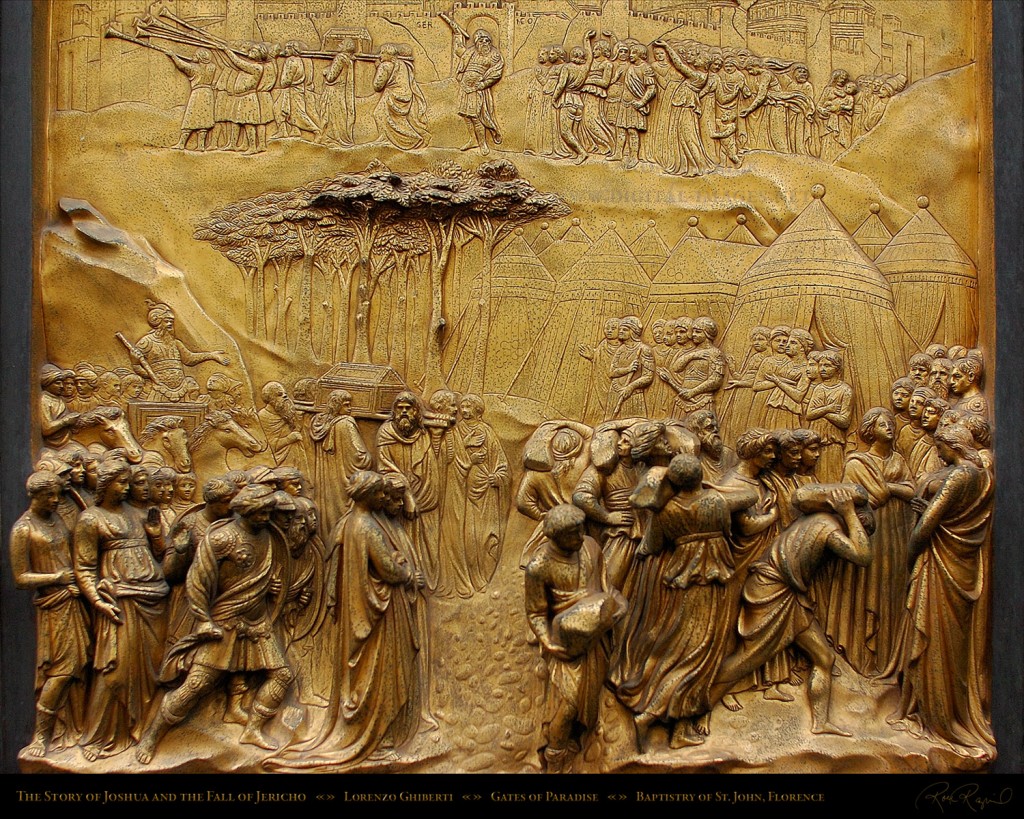
joshua-jerichoDirect speech
By popular definition prophets hear or sense the voice of God directly then obey. Innumerable documented examples reside both in ancient and modern history. About 1,550 BCE the prophet Joshua was told by God to go conquer the land and people across the Jordan River (Joshua 1:1-6), killing all the men, women, and children (Joshua 6:21). After Jericho was razed, on the further commands of God Joshua then razed the town of Ai, killing 12,000 men and women (Joshua 8:24-28). Genocide is not the only command by God either, mass suicide is also spoken by God to the more faithful zealous followers. At the fortress of Masada in 73 CE led by the apocalyptic prophet Eleazar ben Yair, though details are debateable, 960 Jewish revolutionaries committed suicide/murder for their God rather than endure enslavement by Rome.

Jones-Koresh

Jones (left) and Koresh

In modern history three iconic prophets also followed God’s direct speech for mass suicide of all their most faithful zealous followers. They do not need any elaboration here. They were Jim Jones in Jonestown, Guyana (Nov. 1978) of 918 followersnearly 300 were childrenMarshall Applewhite in Rancho Santa Fe, CA (March 1997) convincing 39 followers, and David Koresh in Waco, TX (April 1993) leading 85 followers — 22 of them children/teenagers — to their mass suicide/incineration.

In a 2007 co-authored article by Erich Follath (diplomatic journalist), Manfred Müller, Ulrich Schwarz (theologian), and Stefan Simons (Spiegel Online correspondent) entitled Following Divine Orders which focuses on the Age Old irresistible appeal of religiosity for fanatics, or rather those who are not moderate or “luke warm” about their beliefs:

“According to the three Abrahamic faiths, God only revealed the truth about Himself, humankind and the world to their respective religion; it is therefore recorded separately in their holy scriptures: the Hebrew Bible (the Torah, or Old Testament to Christians), the Christian New Testament and the Islamic Koran.

These [bibles] contain countless contradictions. Both the Koran and the Bible’s Old and New Testaments bear witness to a good and merciful God. They urge humans to live in peace and harmony. This is reflected most clearly in the instruction attributed to Jesus in the Hebrew Bible: “Love thy neighbor as thyself.

But these messages of brotherhood clash with sentiments that condone intolerance and violence: “For I came to set a son against his father, a daughter against her mother …“; “Anyone who loves his father or mother more than me is not worthy of me“; “Do not think that I came to bring peace on Earth. I did not come to bring peace but a sword.” The prophet Mohammed also delivered harsh threats from Allah: “Fear the fire prepared for the infidels.

Throughout history, the Abrahamic religions’ claim of absolute authority has exerted an irresistible appeal on fanatics, encouraging them to impose their own faith on nonbelievers and dissidents alike – if need be by using fire and the sword. To this day, nearly all religions supply the kindling that fuels wars and acts of persecution, sparks torture and murder, and inflames ethnic hatred. Examples abound: the bloody wars between Hindus and Muslims in India, or the enmity between Muslims and Christians in Indonesia.

For centuries, it seemed that the Abrahamic religions had come to terms with – and discarded – extremism. In the case of Christianity, this dates back to the Enlightenment, when the symbiosis between church and state collapsed and a new system of ethics emerged – one that was independent of faith in God and derived solely from social consensus.”

Those above examples of ancient and modern direct divine revelation seriously beg the questions What exactly is the Holy Spirit and how is it (a prophet) accurately tested for authenticity? Anyone who wishes to answer these questions, good luck! I do NOT envy you. There are as many various definitions of the Holy Spirit/False Prophet debate by Christians as there are species and sub-species in the animal kingdom! It is truly unimaginable. Suffice it to say here that almost all Christ-believers, scholars and laypersons alike, ultimately and exclusively refer to their Bibles for definitive Holy Spirit or non-Holy Spirit answers. Naturally, that only leads to more questions. Therefore, “direct speech” is not a religious consensus to really knowing God.

Greek-soccer-fans

Greek soccer fans

It is worth mentioning, the fields of psychology, neurology, and sociology have many theoretical studies associating heightened religious behaviour due to Temporal lobe epilepsy and minor forms of schizophrenia, and sociologists have found that social God-constructs can persuade individuals into states of euphoria because of large numbers of people acting together in a strongly shared belief — crowd psychology or mass hysteria, also known as Mass Psychogenic Disorder/Hysteria. Huge sporting events are good examples of this phenomena. Extreme isolation can have similar effects of hyper-religiosity and paranormal hallucinations, sometimes negative.

The Incarnation
In theological terms, this is simply God in and as Jesus Christ; both God and man simultaneously. The first grave problem with this Christian doctrine is that it is based upon only “Christian-biased” historical sources and traditions riddled with inconsistencies. In other words, who and what Jesus of Nazareth was historically between 6-4 BCE and 30-36 CE, the generally agreed upon lifespan, cannot be verified with absolute certainty outside of the Christian Synoptic Gospels. Many Christian apologists vehemently claim that writings by Flavius Josephus, Pliny the Younger, and Tacitus are non-Christian evidence for the historicity of Jesus. F. Josephus, however, was not completely unbiased about the new Jesus-Movement called The Way by Judean-Christians; he too was involved in 1st century CE Jewish Messianism as a Pharisee. Pliny and Tacitus were indeed Roman and non-Christian, but their very brief mentions are about Christians as a whole, rather than a biography about a specific person named Jesus.

Therefore, the best that Christian-believers can hope for regarding an actual verifiable incarnation of God through Jesus of Nazareth is by Christian scribes and followers 30-90 years after his death based on oral-storytelling traditions. That is the closest that honest scholarship can provide at this time, and beyond that is a question of individual faith within crowd psychology. This now leaves us only with the Bible… what the doctrines of Direct speech and The Incarnation frequently must reference anyway.
(line break)

The Canonical Bible

Many modern Christians are unaware of the origins, early development, and the 2nd and 3rd century CE controversies surrounding the final compilation of their Bibles. Some believers might even think their bible suddenly dropped out of heaven long long ago after God finished writing the 66 books, never thinking to ask “Why just 66 books? Why not 40 or 10 simple books?” And honestly, orthodoxed American society today, including many Christians, know very little of the ancient world of Jesus, the Levant, and the Fertile Crescent.

First_century_Iudaea_province

click here to enlarge

The birthplace of Jesus was Judea, the Jewish province ruled by Rome. Divided by intense religious factionalism, the people of Judea, as well as Galilee, Idumea, Nabatea, and Perea were anxiously awaiting the arrival of the Messiah and God’s salvation. First century CE Romans would have encountered a large mix of traditions and philosophies in this world. The Hebrews had for many centuries suffered foreign invasions and been harshly buffeted by powerful external cultural forces. The most potent of these was Alexander the Great’s Greek civilization supported by several centuries of Hellenistic overlords in Egypt and Syria.

The Jews in these regions were divided over subjects ranging from the legitimacy of the priesthood to the acceptance of certain books into the Hebrew Canon. The Essenes rejected the priesthood entirely. Samaritans formulated their own unique doctrines. Various cadres of Jewish zealots pledged themselves to the expulsion of the Romans. Sadducees made up their prestige with the aristocratic clans making up the priesthood in Jerusalem and exclusive supervision of the Temple. They rejected the books of the Prophets and Writings and also became more ingratiated with Herod and Roman governors who eventually granted them local rule in the Sanhedrin. The Pharisees were more progressive than the Sadducees in that they not only accepted those books, but also believed in angels, demons, resurrection, and — like the Essenes and other groups — passionately in the coming of the Messiah, e.g. the Apostle Paul. The Pharisees also had grown a body of unrecorded commentary on Hebrew Scriptures and rulings by Jewish sages. This was intended to help Jews adapt the ancient Law of Moses to the circumstances of their own time.

Essentially, roots of the Christian New Testament began during this period of great Jewish disunity, alienation, isolation, and confusion before anything Christian was written down. Once Christ-followers began recording an anthology or testaments of Jesus’ parables, prophetic and wisdom teachings, and exhortations — by around 150 CE (over a century after Jesus’ death) — there was no less than 42 testaments or gospels for Christian teachings which were freely circulating as opposed to just 27-books in today’s New Testament. The formulation of the Hebrew Bible, i.e. the Old Testament, went through similar reconfigurations between 500 BCE and 70 CE, i.e. approximately 600 years!

Naturally, all this diversity and variety of who and what the Nazarene was caused more confusing fractures among outlying Christians and Judean-Christians for centuries! It is like trying to answer What is an American?” today in one single description from 324+ million citizens. To learn more about the various origins of Nazarene-Nasorean-Nasara-Nazirite, go here to my bibliography subpage: The Nasara-Nazirites.

map_Roman-Empire_14-117CE

1st & 2nd century Roman Empire

Authoritative or Not Authoritative? 
For over three and a half centuries (between 337 and 389 years!) after Jesus’ death, there existed no standardized written collection about Jesus’ ministry or precisely what he did or taught. Everything known about him (and not known) was by word-of-mouth across 2,000 sq. miles. What is more dubious and astounding is that what little there was written down about Jesus’ message was by a foreigner, a Hellenistic Pharisee named Saul of Tarsus who had never once met Jesus in the flesh, in person. No surprise, after Saul’s ‘paranormal conversion‘ to “The Way” on the road to Damascus, he fell into serious conflict with the Council of Jerusalem headed by Jesus’s next-in-line brother James, Peter, Cornelius, and other Judean-Christian leaders who had personally known Jesus quite well compared to Saul. Yet, today Pauline-Christianity (aka Saul) predominates the New Testament, seminaries, and modern churches. James Tabor, professor in the Department of Religious Studies at the University of North Carolina at Charlotte, writes about this heavy influence from a near total stranger to the Jerusalem leaders… and their and Jesus’ Neo-Jewish teachings. Tabor states:

The fundamental doctrinal tenets of Christianity, namely that Christ is God “born in the flesh,” that his sacrificial death atones for the sins of humankind, and that his resurrection from the dead guarantees eternal life to all who believe, can be traced back to Paul — not to Jesus…

In contrast, the original Christianity before Paul is somewhat difficult to find in the New Testament, since Paul’s 13 letters predominate and Paul heavily influences even our four Gospels. Fortunately, in the letter of James, attributed to the brother of Jesus, as well as in a collection of the sayings of Jesus now embedded in the Gospel of Luke (the source scholars call Q), we can still get a glimpse of the original teachings of Jesus…

What we have preserved in this precious document is a reflection of the original apocalyptic proclamation of Jesus: the “Gospel of the kingdom of God” with its political and social implications.
Christianity Before Paul, The Huffington Post, November 2012 cited Aug. 16, 2016 at http://www.huffingtonpost.com/james-d-tabor/christianity-before-paul_b_2200409.html

With this and other additional alternative extant evidence, one has to ask “What formula was used some 300-years later to configure and reconfigure the vast oral and written testaments/gospels of Jesus?” Hitherto is a list of the most significant testaments/gospels about Jesus of/the Nazareth/Nazarene out of approx. 130 known writings not present in the New Testament today:

Non-Canonical Writings (Incomplete)

For a more complete list of the many known writings of Jesus and his earliest followers, go to the NNU Wesley Center’s page of Non-Canonical Literature.

(paragraph break)

Apostolic Fathers and the Canon Formula

Signs that much of these various Jesus-literatures had been accepted as authoritative by church leaders and early Christian congregations as early as the 1st and 2nd centuries CE appear in the letters of the Apostolic Fathers. During these centuries of the new upcoming churches, no official creed or universally accepted liturgy existed. In the following paragraphs, notice the similarities from the first churches to modern-day Christian churches.

The biggest and most heated controversy was a newer version of an old Jewish sectarian problem:  Are the Hebrew Laws, Prophets, and Writings above, below, or void in light of Paul’s Hellenistic teachings — deeds or faith? Another ongoing spinoff debate was the Gnostic challenge:  There are two dualistic worlds and two Gods, and there was no Incarnation, explained as follows:

  • The World of Darkness was created by an inferior God, the Hebrew God, and so the Hebrew scriptures were rejected or severely de-emphasized.
  • Material aspects of this Dark World, including the human body, were burdens that humanity was forced to endure by the Hebrew God.
  • The World of Light and Knowledge was ruled by a Supreme Being. Salvation was possible only through gnosis of this divine world and the Supreme Being’s mysteries, but salvation was available only to some, not all. Some Gnostics had a three-tiered class system too.
  • There was No Incarnation because he was not the Son of the inferior Hebrew God, nor did he become a man, suffer human pain, or die on a cross. Resurrection was merely a spiritual linking of the soul with the World of Light and had nothing to do with a human body.

Because Pauline Orthodoxy had the support of Rome, Constantinople, Alexandria, and Antioch, and their power and influences of those churches and bishops, by the 4th century CE the Gnostics would quickly be labelled heretics and harshly hunted down and most all their holy literature burned. With the four strongest episcopal sees in the Roman Empire, Ignatius, Clement of Rome, Polycarp, Hermas, and their colleagues along with their heavy power and influence… the weaker episcopal sees around the Empire and the remaining Jewish-Christians in and around Jerusalem simply could not stand up to the might of Hellenistic Constantinian Rome.
(line break)

Victors and Emperors Always Make the “Authoritative” Laws and Histories

Walter Benjamin posited that “History is written by the victors.” Historical records of major social, national, economic, ethnic, or religious upheavals and cleansings bear this philosophy out to some/large degrees. And so with his maternal-influenced-miracle-based sanction of the “official” Christianity, Emperor Constantine not only led the Roman Empire, but was also Head (Pope?) of the Church. He called for unity as a whole within the Church and agreement on its scriptures. Easier said than done inside one of history’s largest empires.

There were no less than seven failed attempts to form an official universal Bible. On the eighth failed attempt by Eusebius of Caesarea at the request of Emperor Constantine, Eusebius’ rejection of the popular Gospel of Peter, Gospel of Thomas, Gospel of Matthias; the Acts of Andrew, of Paul and of John; the Shepard of Hermas, the Epistle of Barnabas; the Didache, 1 and 2 Clement; and the Apocalypse of Peter… got his configuration rejected (see Table of Canonical Debate below). His reasons for classifying certain texts as questionable or spurious had revealed the basic formula for inclusion. Probably more important for him was a writing’s perceived apostolic authorship, though its antiquity and orthodoxy were also of significant consequence. Study closely the following table…

Table Canonical Debate

Athanasius of Alexandria wrote his Easter letter to the churches and monasteries in his diocese identifying the books they were to include in the testaments. Athanasius was one of the more flamboyant patriarchs. He was exiled from his pentarchy five times leading back to the Council of Nicaea due to his unyielding defense and decisions to compromise with other Roman patriarchs (which at times included Eusebius) over controversial points of Christian doctrine. His canon had been later confirmed by the church in Rome in 405 CE, in 393 at Hippo Regius in North Africa, and in Carthage twice, in 397 and then again after the growing Gnostic churches in 419 CE in reaction to the intensifying debate regarding James, Jude, and Hebrews. The Syrians used the Diatessaron as their canon for another 50-years. The Ethiopian church continues to this day to recognize a book of Clement and several other non-canonical books of liturgy. Though the various pentarchy churches had made ground toward unity, it is important to know they were never in absolute agreement on the New Testament canon and Christian doctrines.

Notice from the above Table how even the seven Patriarchs, who were themselves understudies to the Apostolic Fathers, after 300 years still did NOT completely agree on what God’s Son, the Messiah, and the new and old messages was suppose to mean to all people. Yet Constantine, his bishops, and propraetors had to have orthodoxy — a long standing Greco-Roman political tradition.

It wasn’t until around 400-419 CE and centuries of compromise and more compromise that the final configuration of the Christian New Testament was officially closed — closed by the declaration of the Emperor, put into law, and enforced by the torches and swords of his Roman Legions. For a God who is proclaimed as omnipotent, omniscient, and infallible, and whose traits are “proven” in the special revelations of the Canonical Bible, raises the glaring question:

Why was there three centuries of confusion, fracturing, and compromise among its early most prolific theologians… and even still to this day!?

(line break)
For Jews and Christians alike, study of the Scriptures has often been an end to itself — a simple act of devotion — rather than an exercise in absolute truth. These peaceful moderates likely realize today that human interpretation, interpolation, and orthodoxy (individual or group) cannot create an inerrant testimony of the nature of a God, nor of the full nature and teachings of a Jew named Jesus based from ancient oral traditions and differing literature spread over multiple centuries… or from differing regional cultures over 2,000 sq. miles. From an early date, believers then also began to scrutinize the Bible for what it had to say to their own generation and community along with their prolific leaders. Exegesis back then was done for purposes of preaching, pastoral care, formulating codes of behavior, and finding answers to theological and ethical questions not explicitly addressed by the texts.

As it happens today, inevitably back in Antiquity, disagreements arose — over importance of texts, their relative authority to the community, how to account for known inconsistencies and contradictions, and how to explain confusing biblical stories. Like our dear family friend in the kitchen at the beginning, both sides of the debates were probably saying to each other, “Your posture is all merely philosophy and theory.” But orthodoxy nonetheless developed, often based on a pseudo-definite set of human-like rules or patterns regarding multiple meanings and levels of meaning. To imagine there to be just one universal way, one universal lifestyle, one universal truth (e.g. John 14:6), one universal orthodoxy extracted from these millenia of “divine revelations” then and now… is not only an attempt to force a square peg into a round hole, but it is a blatant denial and/or ignorance of historical facts, wide-ranging scholarly critical thinking, reasoning, and probability, and/or a lack of deeper persistent curiosity.
(line break)

Or it could be only tunnel-vision “faith.” Right? (wink)

(paragraph break)

Live Well — Love Much — Laugh Often — Learn Always

Blog-posts for additional information:

Constantine: Christianity’s True Catalyst/Christ
The Suffering Messiah That Wasn’t Jesus
Correcting the Gospels of Jesus
Masada, Texas: How Egos and History Repeat
The “Holy” River

Creative Commons License
This work by Professor Taboo is licensed under a Creative Commons Attribution-NonCommercial-NoDerivatives 4.0 International License.
Permissions beyond the scope of this license may be available at www.professortaboo.com/contact-me/.

Untapped Worlds – Retooling

This is the fifth-part of the series continuing from Untapped Worlds — Reside and its previous four posts.
(paragraph)

The prude is in fact the libertine,
without the courage to face their naked soul.
—- A. S. Neill


Exclusion makes us suffer. Inclusion makes us thrive.
—- E. O. Wilson

(paragraph break)

(paragraph break)

performing-artsWhat does it mean to be more human? Looking back from where humans come can help. Comparing that past to where we are now helps. What would it mean to be more than human? Less than human?

If our history has shown us anything, the great and the horrid, humans must keep up, must be proficient learners, empathizers, and adapters, to best act and react, to fail better and succeed better in a world and Multiverse which perpetually challenges us every minute of every day. This inevitably means breaking old conventions and forming new healthier refined ones…even if it means our initial discomfort and ridicule, and in extraordinary cases, our imprisonment or death. To me personally, this is what it means to be human and more human.

How might we gauge our natural humanity?

Humans and Animals: The Near and Far

Perhaps a first observation can be differentiating humans from other animals starting with body structure. Even the rest of Earth’s other primates have noticeable differences to ours. But delve deeper beyond outer features and there is an overwhelming amount of continuity, until you reach the brains. At the University of Queensland in Australia, Professor of Psychology in Cognition and Evolutionary Psychology-Cognition, Dr. Thomas Suddendorf finds…

The physical similarities between humans and other mammals are quite plain. We are made of the same flesh and blood; we go through the same basic life stages. Yet reminders of our shared inheritance with other animals have become the subject of cultural taboos: sex, menstruation, pregnancy, birth, feeding, defecation, urination, bleeding, illness, and dying. Messy stuff. However, even if we try to throw a veil over it, the evidence for evolutionary continuity between human and animal bodies is overwhelming. After all, we can use mammalian organs and tissues, such as a pig’s heart valve, to replace our own malfunctioning body parts. A vast industry conducts research on animals to test drugs and procedures intended for humans because human and animal bodies are so profoundly alike. The physical continuity of humans and animals is incontestable. But the mind is another matter.

social dolphinsMany would guess our brains to be “another matter” because they are the largest on the planet. Incorrect. The human brain comes in at fourth, technically fifth place. Sperm whales have the largest at 17.5 pounds followed by blue whales at 12.5 pounds, then elephants at 10.5 pounds. In fourth place are dolphins at 4 pounds. Our brain is a distant fifth place at 2.8 average pounds. At a close sixth is the walrus at 2.4 pounds, followed by all remaining animals. Yet it isn’t size that sets us apart, but intelligence. Bertrand Russell asserted that “speech, fire, agriculture, writing, tools, and large-scale cooperation” significantly widens the gap between us and animals.

While those abilities may seem to us and our brains as “higher intelligence”– brains which are prone to deception, memory-errors, superstition, and ambiguity — closer comparisons find Russell’s claims inconclusive. I argue along with Suddendorf that moving the intelligence-bar lower, and maybe less arrogantly, we can find “parrots can speak, ants have agriculture, crows make tools, and bees [as well as ants] cooperate on a large-scale.” Nevertheless, Suddendorf also points out that in those six advanced-intelligence domains:

I’ve repeatedly found two major features that set us apart: our open-ended ability to imagine and reflect on different situations, and our deep-seated drive to link our scenario-building minds together. It seems to be primarily these two attributes that carried our ancestors across the gap, turning animal communication into open-ended human language, memory into mental time travel, social cognition into theory of mind, problem solving into abstract reasoning, social traditions into cumulative culture, and empathy into morality.

Humans are avid scenario builders. We can tell stories, picture future situations, imagine others’ experiences, contemplate potential explanations, plan how to teach, and reflect on moral dilemmas. Nested scenario building refers not to a single ability but to a complex faculty, itself built on a variety of sophisticated components that allow us to simulate and to reflect.

Though we may be the only creatures on the planet with the capacity to time-travel with our imaginations, simulate possible outcomes, and carry out mid-term and long-term plans based upon those imagined scenarios, how much of a contrast does that really create when we still know so little about aquatic mammals (not to mention those oceanic invertebrates and their languages), while the neurobiology and neurocognition of our own brains aren’t fully known? Despite his 2011 scientific misconduct in other areas, former Harvard University professor and evolutionary biologist Marc Hauser expounds on our higher-evolved cognitive abilities and notes four distinguishing abilities…

  1. Generative computation
    Humans can generate a practically limitless variety of words and concepts. We do so through two modes of operation recursive and combinatorial. The recursive operation allows us to apply a learned rule to create new expressions. In combinatorial operations, we mix different learned elements to create a new concept.
  2. Promiscuous combination of ideas
    Promiscuous combination of ideas allows the mingling of different domains of knowledge such as art, sex, space, causality and friendship thereby generating new laws, social relationships and technologies.
  3. Mental symbols
    Mental symbols are our way of encoding sensory experiences. They form the basis of our complex systems of language and communication. We may choose to keep our mental symbols to ourselves, or represent them to others using words or pictures.
  4. Abstract thought
    Abstract thought is the contemplation of things beyond what we can sense. This is not to say that our mental faculties sprang fully formed out of nowhere. Researchers have found some of the building blocks of human cognition in other species. But these building blocks make up only the cement foot print of the skyscraper that is the human mind. The evolutionary origins of our cognitive abilities thus remain rather hazy. Clarity is emerging from novel insights and experimental technologies, however.

I’d draw into further question Suddendorf’s assertion that humans have fully “moved social traditions into cumulative culture” or “moved empathy into morality” or more disconcerting, on a planet of abundant food sources, have we moved jealousy into civil negotiation and altruism, especially toward compersion and less famine? I will explore later what is meant by compersion. Hauser’s four points however, particularly #2 and #4, help us recognize the “haziness” of supreme beings without discrediting the reasons why we may never be able to claim total planetary supremacy for the foreseeable future. Maybe the smarter question is “Why seek supremacy?” Or supremacy in any context. What responsibilities come with supremacy and are human brains capable of such a lofty position? I’d also ask Why not promote more lateral mobility instead of vertical mobility? Certainly less bodies and cadavers under heavy foot with the former than the latter.

Alexander Neill meets Ed Wilson

In the previous post I introduced A.S. Neill and his unconventional approach to parenting and education. I wish to return to him and the impact of external stimuli and nourishment (and malnourishment) for the human heart and mind.

asneill_cottage-storyWhen a child is born do you consider them at that instant to be inherently good, bad, or indifferent? Immediately after an average healthy normal 9-months in the womb, is a newborn significantly altered or influenced toward goodness, evil, or apathy? Do moral and ethical measurements begin during gestation, minutes after birth, or weeks and months after birth?

Believe it or not this is a very controversial topic in parts of the human world. A. S. Neill believed the only source of humanity’s worst behaviours start with parents, then socio-familial groups (their parents), and eventually nation-state ideologies. Neill therefore began a radical form of education by opening a new type of school.  “The merits [of Summerhill School] will be the merits” he explains “of healthy free children whose lives are unspoiled by fear and hate.” Students at Summerhill are not required, forced, or coerced to attend classes. They go of their own accord because they are genuinely interested and want to learn; or they can stay away from classrooms, for years if they choose.

When I first read Neill’s school policies I was stunned. As a teacher of five years in traditional public schools, I could only relate to my students, my campuses, and my childhood as a student with other students. My boyhood schools and the schools I would later teach in classrooms would have been zoos had the students had that much freedom! When I was a school boy I probably would’ve been just as deviant. I soon recognized I now had a serious conflict — I do not believe children are inherently evil at birth, nor into their toddler years. This caused me to seriously re-evaluate major and minor aspects of my life; aspects as a father, former teacher, and active U.S. citizen! Change was again in my front door.

In an October 2011 article by The Independent (U.K.), correspondent Sarah Cassidy interviews several alumni of Summerhill School.

It is one of the most famous schools in the world; a place where every lesson is voluntary and where youngsters can vote to suspend all the rules. Founded by the liberal thinker AS Neill, Summerhill turns 90 years old this year.

Famous alumni of the democratic or “free” school include actress Rebecca de Mornay, children’s author John Burningham and Storm Thorgerson, the rock album cover designer.

Other graduates include Michael Bernal, PhD in Mathematical Physics, Hylda Sims, novelist, poet, songwriter, event organizer in greater London, and Freer Speckley, International Development consultant for online facilitation and training. Author Hussein Lucas in his book After Summerhill interviews twelve other graduates and concludes:

The key feature that sums up the distinctive nature of the Summerhill experience is the virtual absence of fear: fear of failure; fear of authority; fear of social ostracism; fear of life and the consequent failure to engage with it with a feeling of optimism and a positive outlook.

If Lucas, Summerhill School, and its graduates, as well as founder A.S. Neill don’t sum up the enormous impact of human influence and interaction on a child’s and teenager’s formative educational years, then it certainly highlights social coping mechanisms during the adult years; years rot with fears of failure, authority, ostracism, life (suicides?), agoraphobia, and pessimism. I’ve watched several of these toxins develop in my sister for 40+ years and in a span of 7-days my father’s suicide. Personally, it took about four years of therapy for me to conquer my unhealthy codependency; as opposed to much healthier forms of human connection and love. I will explore several of these forms later. Meanwhile, where do these fears originate? Are they hardwired into us prenatally or do we contract them like air pollutants when we encounter other fear-bearers? How is fear justified or unjustified?

a.s.-neill

Alexander S. Neill

The question of fear’s origins is as much a question of timing as purpose. For an adult or a person capable of self-evaluation and adequate self-reliance, fear in its most basic form is a matter of life or death. We know or have been conditioned and/or educated that running red traffic-lights at intersections is taking your life into your hands, other driver’s hands, and others inside the vehicles and of nearby innocent bystanders. We know that fire and extreme heat along with smoke inhalation will kill us. We know that various weapons will terminate life (immediately?) when put to and/or fired at the head. We know that massive brain aneurysms or coronaries usually end in quick death. We know approaching certain wild animals who are in fear for their own lives or their offspring’s, or are merely very hungry, is chancing a violent death. The “timing” of this recognition comes much later in age after conditioning or retained educated fear. They are healthy fears or respect to those specific dangerous situations learned over time, i.e. realized fears. Infants, toddlers, or adolescents have not had the luxury of time or experience to learn necessary life-or-death fears. For better or for worse, the teaching and protection for life-safety and avoiding death, or realized fears, are in the parent’s or guardian’s hands. However, there can be the improper mixing of unrealized fears with life-or-death ones. This is where A.S. Neill diverges from traditional child-rearing and education. His postures can easily traverse our age groups.

It may be no exaggeration to say that all children in our civilization are born in a life-disapproving atmosphere. The time-table feeding [the mother’s breast milk or later] advocates are basically anti-pleasure. They want the child to be disciplined in feeding because non-timetable feeding suggests orgastic pleasure at the breast. The nutriment argument is usually a rationalization; the deep motive is to mold the child into a disciplined creature who will put duty before pleasure.

Neill goes on to give specific child-student scenarios denouncing repressive conditioning to fit-in, be acceptable, and fulfill duties of the state while being ashamed of individual passions and emotions, even self-awareness. Furthermore, these “unfree” conditions repress imagination and ingenuity, the very building blocks of refinement, progressiveness, adaptation, and pragmatism.

To sum up, my contention is that unfree education results in life that cannot be lived fully. Such an education almost entirely ignores the emotions of life; and because these emotions are dynamic, their lack of opportunity for expression must and does result in cheapness and ugliness and hatefulness. Only the head is educated. If the emotions are permitted to be really free, the intellect will look after itself.

The tragedy of man is that, like the dog, his character can be molded. You cannot mold the character of a cat, an animal superior to the dog. You can give a dog a bad conscience, but you cannot give a conscience to a cat. Yet most people prefer dogs because their obedience and their flattering tail wagging afford visible proof of the master’s superiority and worth.

Much of this Western social-political thinking and lifestyle stems from Antiquity between 300 CE until, in various subtle forms, the modern 1960’s and 70’s. The mentality is known as total depravation indoctrination as taught to the world by extreme Abrahamic religions upon the uneducated illiterate subjects of the empire. Neill writes…

The problem child [and adult?] is the child who is pressured into [holiness and piety] and sexual repression. Adults take it for granted that a child should be taught to behave in such a way that the adults will have as quiet a life as possible. Hence the importance attached to obedience, to manners, to docility.

If the condition of depravity isn’t taught outright by Abrahamic clergy and churches, it is certainly perpetuated by the obsessive perfectionists or tyrants of the world intolerant of responsible and total human freedom.

“The prude is in fact the libertine, without the courage to face their naked soul.”

Indeed. And there is another renown scientist and Naturalist that would echo much of what A.S. Neill claims. He advocates a return, if not at least a constant remembrance, to who we really are and where we actually come from. His name is Harvard graduate, social-biologist, and naturalist Edward O. Wilson. In 1979 his book called On Human Nature won the Pulitzer Prize. He has since authored other acclaimed books such as The Diversity of Life, Naturalist his biography, Concilience: The Unity of Knowledge, and in 1990 co-authored and published with German behavioral and evolutionary biologist Bert Hölldobler the book The Ants that won his second Pulitzer Prize.

Advanced Social Behavior and Who Has It

Sociobiology has only recently become a scientific field of study: the mid-1970’s. E. O. Wilson defines sociobiology as “the systematic study of the biological basis of all social behavior” whether human or non-human. Because many human intellectuals and human groups regard Homo sapiens as highly advanced, Wilson’s theories and definition of sociobiology flew in the face of old “supremacy” traditions, particularly of the divine persuasion. But as I reflect back on human history, the brilliant and the atrocious, and how Homo sapiens behave toward and treat each other despite social labels and imaginative beliefs, I want to hear-out everything Wilson has to say. In fact, it might be intellectual suicide or quicker extinction not to.

eo.wilson.ants_.men

Edward O. Wilson

Earlier I compared differences between humans and animals. Bertrand Russell asserted that what sets us apart from other species was intelligence; speech, fire, agriculture, writing, tools, and large-scale cooperation or social behavior. Thomas Suddendorf further expounds that humans are avid scenario-builders and time-travellers, being able to bring into existence what our minds created in the past. And Marc Hauser asserted that with our highly cognitive brains we are able to generate complex computations, promiscuous combinations of ideas, mental symbols, and construct and contemplate abstract thoughts. Along with these advanced abilities and skills we seek to share them with our own kind in order to survive better, easier, and advance our species, especially those we love and cherish. This is called eusociality. From the field of biology, Wilson asked “Why did any animal, whether human or insect, evolve complex societies and behavior?” and from his research he defines eusociality as exhibiting three characteristics:

  1. Groups of individuals within that species living together for more than two generations.
  2. Adults caring for the young; usually intimately caring for them.
  3. They have to have a reproductive division of labor, i.e. some of those individuals in that society have to be giving up part of their longevity, perhaps, or at least reproductive capacity to serve the others; in other words, real altruism inside the group.

Out of the 10-million estimated living species on Earth, we only know about, study and understand 2-million; and of those 2-million living species, only 19 of them are truly of eusocial evolutionary lines. Sixteen of them are insects. Another aspect of eusociality in insects, like ants or bees, is that an individual serves the survival of the whole and act in almost perfect syncronization with other individuals in the entire colony, called the superorganism. This same behavior is called altruism in human contexts.

The only eusocial primates are Homo sapiens, us. Therefore, being the only primates with the advanced social behavior of eusociality coupled with highly developed cognitive skills Suddendorf and Hauser point out, can we learn anything more from the species who have been eusocial the longest, over 120-million years? Wilson thinks so. He has spent his entire life studying insects like ants. In fact, Wilson asserted in the 70’s that human social behavior, origins of human emotional mechanisms and instincts, evolved in the same ways as those other 18 eusocial species: in nature. This caused a firestorm not only among biologists, but social scientists and activists as well.

The Sociobiology Wars

In 1975 Ed Wilson suggested that social behaviors like human bonding and morality must have a biological neurological basis. They must have evolved. “The time has come” said Wilson, “for ethics to be removed temporarily from the hands of the philosophers and biologicized.” Social scientists and activists of that time did not take too kindly to his “regressive” claims. Back in the 1970’s the fields of psychology, sociology, and philosophy had fought long hard battles against late 19th century, early 20th century ideals of racism and sexism, and won or at least made progressive strides toward winning. Ed Wilson was seen as regressing backwards to those barbaric racial hierarchies and patriarchal ideologies. His naysayers at that time imagined he was attempting to revive those old discredited social systems and that human nature could only be understood through biology and genetic manipulation benefitting a race or gender.

Jonathan Haidt, social psychologist at New York University and Yale University/University Pennsylvania alumnus, explains the heated controversy Wilson found himself:

“The most sacred value of anti-racism and also related, anti-sexism was anything that remotely threatened those values would trigger a nerve and those groups would go haywire! And that’s what happened [in 1975-76]. Ed was simply saying ‘Well, maybe human nature is innate, maybe we evolved with a division of labor between men and women.’ Woah! You’re saying that there could be genetic differences between men and women!? But that could justify sexism. That could justify paying men and women differently! Therefore, it must be wrong!”

There was even a manifesto entitled Against Sociobiology written by several of Wilson’s colleagues at Harvard from their biology department denouncing Wilson’s sociobiology and that it could license racism, sexism, slavery, and genocide. Some demonstrations and picket-lines on the campus turned verbally abusive. After a class lecture Wilson gave he required a police escort out the back doors. But Wilson withstood the storm and stood his ground.

As more studies, research, and data poured in over the 1990’s and into the 21st century in the fields of psychology, genetics, anthropology, neurology, and other related fields, it seems to be increasingly plausible, Wilson says there are indeed “general properties of the way the human mind develops and children acquire culture, preferences, and biases adopted by people that have a biological nature.” If there is one benefit afforded the modern fields of psychology, genetics, anthropology, and neurology by E. O. Wilson’s battle scars, it is the free-range deeper exploration and study of human nature against the backdrop of biodiversity.

Being and Becoming More Human

A. S. Neill and E. O. Wilson have opened the roof on human nature by examining human sexuality, human aggression, human dominance, human collaboration and learning, and human emotions like fear, anger, jealousy, pride, guilt, sympathy and empathy through a biological lens.

“It is one thing to observe that we must have a human nature, quite another to discover what it is and how we came by it.

Exalted we are, written to be the mind of the biosphere without a doubt, our spirits uniquely capable of awe, and evermore breathtaking leaps of imagination. But we are still part of Earth’s fauna and flora, bound to it by emotion, physiology, and not least, deep history.”

Neill and Wilson show we are inexplicably part of the natural world. Our minds and emotions evolved in and from nature and with each other. Understanding nature and biology means understanding that evolution. That evolution began between 100,000 and 200,000 years ago on the continent of Africa.

Just as our biosphere supports us and is supported by some 10-million estimated species today in various ecosystems all over the world, paleoanthropologists have revealed we humans also come from a diverse background of at least 13 different bipedal hominids to-date: Homo sapiens likely from Homo naledi, less likely Homo neanderthalensis or Homo floresiensis, then from Homo heidelbergensis or Homo erectus, then from Homo rudolfensis or more likely Homo habilis, then Australopithecus sediba, a yet unknown or unspecified but likely Homo species now being studied, then less likely the Australopithecus garhi or A. africanus, then Kenyanthropus platyops, then Australopithecus afarensis, to finally Australopithecus anamensis from 4-million years ago and at least four more species (Ardipethicus) dating back to around 6 to 7-million years ago. Every single one of these above listed species have similar body traits to modern humans; less so further back in time, increasingly so nearing our 100,000 – 60,000 year genetic markers.

It wasn’t just the physical human form that originated in Africa. It was also our human nature; our biological-neurological natures. Today, paleoanthropologists have a much clearer picture of how our human brain developed. How the frontal lobes expanded over millions of years into the 2.8 pound mass and shape we have today. But what has been lacking in science the last several centuries has been the meaning of humanity…the origin of our social behavior. When and how did humans go from being social, like primates today, to being intensely cooperative building astounding civilizations together?

Tomasello-chimps-childrenDr. Michael Tomasello is the co-director of the Max Planck Institute for Evolutionary Anthropology in Liepzig, Germany. A Duke and University of Georgia alumnus and comparative psychologist, since the 1990’s he has studied “the unique cognitive and cultural processes that distinguish humans from their nearest primate relatives, the other great apes.” Tomasello’s work has earned him many awards, the latest being the Distinguished Scientific Contribution Award by the American Psychological Association in 2015. In his developmental research he has focused on how human children become cooperating members of cultural groups, focusing in recent years on uniquely human skills and motivations for shared intentionality: joint intentions, joint attention, collaboration, prosocial motives, and social norms. Tomasello:

“If the last common ancestor of humans and apes was like modern-day great apes, it was a pretty competitive individual. Fighting for food every day and maybe cooperating a little bit. And what had to happen in human evolution is that humans had to become more cooperative to live in the kind of societies that we live in today.”

The transition from being somewhat social and cooperative within not just familial ties, but in a small group, to being ultra social and cooperative beyond family and small groups was indeed our species greatest moment. It is exactly what removed us from the majority of all primates and other animals, and into that unique distinctive group of 19 advanced eusocial species, and arguably above those other eighteen. Ants did it about 150-million years ago. Humans followed about 1-million years ago when our ancient ancestors developed advanced cooperation defending their campsites and young. Dr. Haidt adds…

“…that transition from being like chimpanzees, that are highly social, to being eusocial, being able to work in very large groups, even with strangers, as we are doing here today. None of us are siblings, but we’re all working together really well because we got all these moral emotions. We are built for this stuff.”

Comparing today’s chimpanzees — the closest genetic relative to humans at about 0.1% difference! — with young children age 1 to 6 years in controlled experiments, time after time shows one singular significant difference in social behavior. Dr. Tomasello determined through cooperation tests one innate feature which sets us apart, as children, from chimpanzees and other apes.

“There is food on a board, and a rope is strung through [carabiners] in the board, so that if one [child or chimp] pulls, it just comes out [disconnected]…you have to pull at the same time to get the board to come inward. If you split the food, one part of the food on one side of the board and one part on the other side, both children and chimps pull it in and are quite successful. But when you pile the food in the middle, the children are still quite good at [cooperating and sharing], they take around half each, and they keep cooperating trial after trial, but with the chimpanzees, everything falls apart because the dominant takes all the food, the subordinate says, ‘What’s in it for me?’ and that’s the end of it.”

Another experiment Tomasello and the Max Planck Institute uses to demonstrate innate eusociality and altruism in human child behavior versus chimps is this fascinating 5-minute video:

A. S. Neill would be extremely pleased with these experiments, with Tomasello, and the Max Planck Institute because they show how toddlers and young children have been wired for altruism, cooperation, and fairness over hundreds of thousands of years. When the opposite behavior is exhibited — e.g. bullying, greed, debasement, psychological egoism, rational egoism — suffering ensues and it begs the question, has that person or group devolved or succumbed to very ancient primate behavior due to choice, genetics, or environment, or all three? Neill and Wilson say humans from birth cooperate instinctively. Whether we stop or continue is a question of teaching, parenting, and community. And sadly to some extent, the available (and shared) wealth and resources and ecosystems Earth abundantly provides. Here we learn what it means to be more human, or less human.

Pushing Beyond “Advanced” Homo Sapien

The term Homo sapien is derived from the Latin homo, meaning man + sapien, meaning wise or rationale. I would like for us to soon become a new species, Humana participatio. This is already happening in certain pockets of the world.

What does it mean to be the Latin Humana participatio? Well, humana is Latin for human being, and participatio means simply sharing. But the act of sharing isn’t just giving what we are or have, it is also about connecting, or in Latin connectens. Thus, I also need to state Humana connectens-participatio! What I mean by that is a sharing of our entire being and a receiving of another’s. It is a flowing two-way connection. And since all humans have the innate want to “distribute knowledge” and experience (more sharing via strong, weak, or absent interpersonal ties) as well as receive knowledge and experience from others and our world, it isn’t or shouldn’t be limited to just two-way connections, but multiple connections. After all, that is how Homo sapiens took the giant leap ahead…over all other primates! Can it be done again? More fully? Personally, I think so; much of the genetic wiring is already present.

Where can we start?

There are a number of human areas to tackle and a number of biological-ecological areas too. The biological-ecological domains are already being addressed, several with fierce opposition, like global climate change and social inequality, but the noble efforts have been recognized, awareness and education has risen, and there are changes in progress. But by comparison and contrast, those advancements seem to be the easiest of the two. They are external changes and progression, not intimate internal ones. Why are outward external issues typically addressed more quickly compared to internal intimate ones?

There seems to be at least two hurdles that give us, advanced homo sapiens, progressive problems:  1) those unrealized fears mentioned earlier, and 2) the Path of Least Resistance; in other words, simply because we are such eusocial beings, it is important that we FEEL included and not excluded by our peers…so we are greatly tempted to take or remain on the Path of Least Resistance. This sometimes (often? always?) does not bode well for progress, for needed evolution, or for dire adaptation.

On the other hand, there are many primus Humana connectens-participatis around the world without or little unrealized fears or lounging in/on the PLR. Their prominence and times around the world might surprise you…

  1. Abolitionists, or opponents to any type of human slavery; at least 70 groups worldwide and well over 260 individual leaders, historically and contemporary. Some 200 of those 260 individuals were/are not of African decent.
  2. Chinese Dissidents, or intellectuals who push the boundaries of society or criticize their governments; currently 36 individuals detained or jailed, 17 to be arrested upon return to China, 13 to be refused reentry into China, and 29to be dealt with” by the Chinese authorities and leadership.
  3. Civil Rights Leaders and their organizations; at least 126 individuals throughout history and today.
  4. Activists for Disability Rights, fighting for equal treatment for those with physical and mental disabilities; some 59 individuals.
  5. Feminists, or the advocacy of women’s political, social, and economic rights to equality with men; at least 772 advocates (male and female) from the 13th century up to today.
  6. LGBT Advocacy Groups, or social-support groups or organizations advocating equal rights for sexually non-traditional, non-binary, non-hetero relational people, couples, and groups; 13 international groups, and well over 1,000+ groups in various nations around the world and on most continents, along with twice as many individuals, and growing annually.
  7. Anti-war and Peace Groups, with over 200 anti-war organizations worldwide, past and present, and well over 300 prominent individual activists.
  8. Women’s Suffragists and Rights expands even further the Feminists list above, past and present.

As you can well see, there have been plenty of primus Humana connectens-participatis among us and there are many around us today who ignore those hurdles of unrealized fears and the temptation of the PLR. They have helped humanity push beyond our walls of 200,000 years as Homo sapien and they invite the rest of us to leap forward with them.

A Further Proposal

I mentioned earlier that there are two domains in which modern humans can influence change and progress:  A) the external and outward biological-ecological systems which truly need our utmost steadfast attention and care, and then B) the internal emotional and cognitive systems. It is the latter domain that is much less known and understood, as a group and species, and therefore by default too often falls by the wayside. If this “default” does not change in time, then it is my personal opinion that we are doing a great disservice to ourselves, our loved ones, our species, and our planet…and as a consequence we will continue to struggle or stagnate in near-primate social conundrums incapable or crippled to keep up as proficient learners, empathizers, and adapters; to best act and react, to fail better and succeed better in this beautiful daunting world and Multiverse we live on, in, and amongst. Diversity gives us the strength and higher virtues to become more human. Singularity, strict conformity, judgement, individualism makes us weaker, less human.

“Exclusion makes us suffer. Inclusion makes us thrive.”

I propose two assignments, two goals to achieve. First, learn and live compersion or higher levels of compersion. If you are a parent, you have experienced or are likely already familiar with compersion. It is the feeling of joy one has experiencing another’s joy, such as in witnessing your toddler’s joy or another’s toddler and feeling joy in response. There have been many wise axioms that expand the essence of compersion. One such adage is if you love someone/something, let it go. If it returns, it is yours. If it doesn’t, it never was. But that’s not all. It is also the feeling of joy associated with seeing and feeling a loved one love another, including your intimate partner(s) or spouse. This is perhaps one of the ultimate forms of compersion in an age-old society of restrictions and repression. What those confining social dynamics cause are unrealized potential, even brilliance and/or unknown euphoric levels of happiness, joy, and connection. Clearly what is NOT present during compersion are its opposites:  jealousy, greed, anger, verbal or physical abuse/threats, selfish-hoarding, and even hints of solipsism. Learning to better manage our “darker” emotional traits (in controlled structured environs; BDSM?) is a means to rule over them rather than they rule over us and others — when and how to switch them on and off. In some respects, those darker behaviors are used to benefit individuals and groups, much the same way an athlete and athletic teams painfully push physical and mental limits to become better.

The second assignment or goal is therefore to redefine, or retool, or liberate our lifestyle, our personality, relationships, affecting our world and environment, and our conventions, then doing the same to our deathstyle. These are the six areas I will explore in the next post of the series Untapped Worlds — Maior Liberatio. I hope that I have not encumbered your reading brains and eyes too much here, and you will join me for the next installment, the last one… I think. 😉  Meanwhile, please feel free to share your thoughts and comments on this series and post below!

(paragraph break)

Live Well — Love Much — Laugh Often — Learn Always

(paragraph break)

Creative Commons License
Blog content with this logo by Professor Taboo is licensed under a Creative Commons Attribution-NonCommercial 4.0 International License.
Permissions beyond the scope of this license may be available at https://professortaboo.com/.

And It Begins

Let’s not mention grandchildren right now. I’m only just grasping that my little Tori married her middle school Sweetheart!” I replied to my new father-in-law.

Holy Sh*t! I could soon be a grandfather! Noooooooo! This does not make me feel invigorated, or young, or ready. Her mother and I didn’t marry until I was 35-years old and she 25-years old. Why, why, why did she start two months into 21!? Her new husband is only 22! Who in their right mind thinks they’re truly ready for marriage so young? Really?

Then I met and spent time with the groom’s parents and family… and the laughter almost never stopped.

* * * * * * * * * *

Rewind Several Months and Hours

ringsOver Spring Break 2014 my daughter and son were with me and my family. What we all suspected was confirmed by Tori: she and Riley would indeed marry in May 2016 after they both finished undergraduate studies and received their Bachelor’s degrees. Everyone thought it a very good idea, especially me. I wanted to talk about so many things because I’ve essentially missed out on the majority of my daughter’s life due to our 2002 divorce and then their mother remarrying and moving over 300 miles away with both my daughter and son. I’ve missed out on 14-years to be exact, and counting. I had been LONG WAITING for the days she and I could become closer, talk more, without the subtle influences and distractions of her maternal family and religious fundamentalism. Now I must share her again and more. No, not what I had in mind!

But how does one compete with deep young love? How can I compete with a boy — now a man — who’s had my daughter’s heart since 10th grade? I am a little jealous. He has no idea how long I’ve been waiting for her! I raise my arms to the sky and let go a roar and scream that would make Tarzan cower!

Then the summer rolls around and SURPRISE! “We are getting married this May!” she tells me on the phone and everyone else. My jaw hits the table, my eyes bulge and I don’t breath. The very first thought that comes to mind as to WHY they feel they must rush it and push it up a year is… well, all of you are probably thinking the same thing I’m thinking.

She’s pregnant.

Tori begins to chuckle, “No Dad. I am not pregnant.” Whew! I didn’t even have to ask because given her mother, her father (me, not step-dad), and BOTH grandparents, out-of-wedlock babies run rampant in our families. Apparently we are all highly sexually energized and she has had this driven into her brain most of her life! 😮

Unplanned difficulty #1 avoided. Long exhale. Now for #2: I am so not ready for an expensive wedding a year earlier! I am a long-term but Substitute teacher working two other part-time jobs just to make ends meet! This is not going to develop well… for me. Traveling over 300-miles, lodging, meals, gas to and from, are not cheap especially on my meager wages. I’m stressed for the next several months, cutting more corners financially to save… somehow. I have no clue how.

Cats, Dogs, Cows, Elephants, and Even Whales!

Fast forward to May 22, 2015, the Friday before her wedding weekend. Not since around 1989-90 has north Texas — and many parts of the state — seen such record rainfall in a matter of hours and consecutive days. Getting 7″ to 10″ of heavy rain in two hours is unheard of in the annals of Texas weather. As I’m preparing for the trip down toward Houston, the local police and fire departments are explaining all the evacuation procedures for our park. Most all the lakes including the one I’m living on and near, are less than 1-foot from spilling over their dams. The river basin they pour and dump into runs all the way into downtown Dallas, beyond Houston, and into Galveston Bay on the Gulf of Mexico. My park, our RV park sits less than 1,500 feet from the banks of this river. Meteorologists are expecting the heavy storms to last until the following week. If I leave, I may return to a flooded out (or floated away) RV. I can’t miss my daughter’s wedding. I decide to go anyway. Saturday night is her (non?)rehearsal dinner.

wed_victoria_May2015-1

My daughter in her wedding dress

The trip to Conroe is about three and a half hours down… down river that is. My ex-live-in-girlfriend, who spent much time with my kids when they still lived in the Dallas area, is also going with me. For the first two hours we drive in such heavy storms that I can’t see more than 45-yards in front of my car. To say it was raining cats and dogs is a gross understatement! The entire animal reserve was coming down on us, even sperm-whales! Yes, that was an intended family pun. The highway (I-45) is normally a 65-75mph speed limit. During three different long phases of the trip, we move no faster than 40mph. We left the DFW area at such a time as to allow us two to two-and-a-half hours to check-in, unpack, shower, and relax before the huge dinner. Two hours until the dinner begins, we are not even halfway there… still on the interstate. My wonderful ex-girlfriend/soul mate suggests calling my mother and we quickly shower and change in her room since their hotel is much closer to the restaurant. Fantastic idea!

With about 20-minutes to spare, we arrive at her hotel, unpack our suitcases, grab the key they left at the front desk, shower, change, pack our stuff BACK into our suitcases, run back out to the car, repack the trunk, then roll into the restaurant only 10-minutes late, somewhat dry and out of breath. My hands are sore from holding the steering wheel so tight. Simultaneously, my ex and I both say, “I need a DRINK!” We don’t mean water! We’ve had enough water for one full day. We’re about to devolve and grow ‘effin gills and fins!

The (Non)Rehearsal Dinner

My ex and I walk up to two rows of tables of 40 guests each. Our empty chairs are across from my Mom, her boyfriend, my sister, my paternal aunt and uncle, and next to the step-dad who is next to my ex-wife. Further down to my right is the maternal grandparents and two of the uncles and wives. To my left are cousins of the groom and their family. Everyone has started on drinks and appetizers. My daughter is the first one to stand and hug me. Her fiancé shakes my hand, they both hug and greet my ex-girlfriend. “I’m so glad you both made it!” she tells us. “We swam some of the way” I grinned. Then the groom’s father stands from across their table to shake my hand; we reaquaint ourselves from my daughter’s high school graduation three years earlier — in the back of our minds we’re thinking drinks, DRINKS please, as we smile and chat. He introduces his wife to my ex, they exchange greetings. We can’t seem to sit down just yet.

Then my son grabs me, gives me a huge hug “You two finally made it!” It seemed he had grown another inch or two since last Xmas. Ethan gives my ex a big hug too; he really liked her when we were together. My ex loved him immensely and missed them both. She too was amazed how tall he had gotten. We turn toward our chairs, but then face more family to greet and exchange formalities with — grumbling in my head, we still have no drinks. We can’t sit down to even order them. Meanwhile, everyone else seems to be on their second or third cocktail.

After we’ve said hello to all of my family, I turn to my kid’s step-dad and shake his hand hello. Quick and pleasant, like it should be. Now we finally get to sit! But there are no staff to take our drink orders because they are serving appetizers to everyone. My ex and I look at each other with crazy-eyes, “are you kidding?” as we both laugh. We’re both ready to steal drinks from family or guests gone to the bathrooms! Clubbing someone over the head is not out of the question either!

Minutes later I finally corner one of our waitresses and order four margaritas, two for both of us. When they arrived not soon enough, you would’ve thought we were inhaling the finest nectar on Earth as we moaned with pleasure. My ex leaned over and whispered “I want to gulp my down, but I don’t want to look like a lush or alcoholic!” I looked at her with this puzzled expression, “Don’t worry” I explained, “the divorced-in-laws (i.e. my ex-wife’s family) probably think we drink too much and have too much fun anyway. I’ll gulp if you’ll gulp!?” Ahhhh, we both smiled setting our glasses down. She whispered again to me, “Did you bring in the bottle of tequila?” If it wasn’t so big, I would have!

Though those were very stressful hours on the highway — what highway we could actually see — the drinks, dinner, conversation, and food were superb. Unless this post becomes 4 to 5,000 words long, I can’t go into detail of just how much we enjoyed the evening. Those two-and-a-half hours were a lot of fun, especially as the groom’s father moved around talking with everyone and making us all laugh. He encouraged us all night to order whatever our hearts desired. It was exactly what we needed after the boat-ride down in the USS Professor.

The Wedding Ceremony

Some of you who know me well know that my ex-wife, the step-father, and the maternal family are ultra-conservative evangelical Fundamentalists. The wedding ceremony and vows was most certainly going to be representative of my ex-wife’s beliefs and as such my daughter’s and how she was raised by her mother. My daughter by now may or may not have the full picture of how… how can I put this(?)… over-bearingover-seeing” her maternal grandfather is and interjects his and his own family’s long-line of beliefs into her mother’s life as well as her own. But I knew preparing for this wedding she would get a more pronounced idea.

Yet, even I was amazed how super Fundy and overly-biblical the ceremony turned out to be. All sorts of Paulian theology and New Testament quotes were flowered into the marriage-ideals and vows as her maternal grandfather was the presiding minister. That surprised me greatly. I expected one of the staff members of her own church to do the honors! In hindsight, I can probably explain why the grandfather did it:  he happily did it for free since the “biological father” couldn’t afford the expenses of the wedding. With equal reason(s) the evangelical Fundy beliefs had to be presented.

It was a VERY serious wedding. Fortunately, the reception afterwards was not as… stuffy? (wink) I have included a few pictures of the ceremony here because my daughter looked amazing! Her new husband Riley is also a big futebol/soccer fan. We always have tons to talk about when together. I like that! Score major points there Tori. 😉

This slideshow requires JavaScript.

Groom’s Father and Family

Now I’ve reached the most pleasant, the most enjoyable and relaxing part of the wedding weekend:  the groom’s father and family. Correction, the second most pleasant, enjoyable, relaxing part. Being with my daughter at her wedding and having my ex-girlfriend with me was clearly the first! But me and my Mom were wonderfully surprised by how much fun and how moderate the groom’s family turned out to be by comparisons. They knew how to have fun and laughed so easily!

They were all staying at the same hotel with my Mom, her boyfriend, my sister, and my aunt and uncle. Consequently, we had an opportunity to spend some time with them away from wedding-stuff and post-wedding. My Mom had the chance to spend much more time with them — my hotel was 30-minutes away in the next town, sadly. But we did manage to chat with them Sunday night.

As it turns out, my daughter’s in-laws are not so religious and serious. Or to put it another way, they are not so heavily convicted or obligated(?) to preach or “share the gospel of Good News” with everyone, especially sinners — which turns out to be good because me and my family are jovial “well-known” sinners. We were quickly drawn to them and as it also turned out, the groom’s father and my Mom’s boyfriend had a lot in common. Both of them grew up on the farm in the country. He up in the state of Iowa, my Mom’s boyfriend here in Texas. They both knew a lot about hunting, guns/rifles, and gutting, skinning, and cooking your kills. Listening to them all talk and laugh, I realized that they were just regular people who seemed not to care much about anyone’s religious beliefs or non-religious beliefs. It was so liberating to discover! For the last ten or more years I had assumed that my daughter, along with the close help of her mother and step-dad, would have to date a “like-minded” like-committed boy/man, especially to marry him. This may not be the case.

However, I can’t jump to certain conclusions, yet. As I’ve mentioned, I’ve missed out on the last 14-years of my daughter’s life. Riley’s personal beliefs and those of his family’s might be as hardcore as Tori’s mom and her family. They just didn’t show it over the weekend. Nevertheless, this was a fantastic start, from my perspective, for my daughter’s new life… and perhaps my future grandchildren.

* * * * * * * * * *

Above in the slideshow of wedding pictures, there is one with my son walking Tori down the aisle. That is when my eyes welled-up and I started sniffling. When she arrived up on stage, I had to wipe away one or two tears. Yes, as any father would say about his daughter at her wedding, she looked stunning. But not only do I mean it, but she truly does/did! She has inherited some great genes! Not only genes of beauty, but of high intellect too. Tori is indeed a fabulous girl woman and Riley, as well as his Dad, told me how lucky they feel to have her in the family.

Toward the end of the wedding reception, Tori was making her goodbye rounds before changing into their traveling/honeymoon clothes. We looked at each other, took deep breaths, smiled, and I told her…”And it begins.” I grabbed her and didn’t want to let go holding her for several lengthy seconds. I felt as if I might have to wait longer now. She chuckled at the thought of trying to escape me.

But then again, how long can a single, twice-divorced father hang on to his daughter when “a lifetime of love” awaits? What a strange funny thought. But for a husband and/or father, isn’t that life?

Live Well — Love Much — Laugh Often — Learn Always

(paragraph break)

Creative Commons License
Blog content with this logo by Professor Taboo is licensed under a Creative Commons Attribution-NonCommercial 4.0 International License.
Permissions beyond the scope of this license may be available at https://professortaboo.com/.