2017: Our Past, Present, & Forecast

Surprise! I am not a fan of horse-blinders, headless ostriches, or one-tree forests. I am not a fan of shallow, baseless rhetoric or opinion unless it is cleverly woven with satire and parody. Nor am I a fan of closed systems and strong-armed boxing in. Are you asking “What on Earth is he going on about?” Fair question.

What 2017 will become for Americans, and hopefully to a minimal extent the world, will be or has been partly determined by 2015-16, the state-of-the-Union and its unionists today, and what will result in 2018 and 2019 based on the past and present. This is the final post from the previous:  2016: Cries for Mutiny.

* * * * * * * * * *
(line break)

The Past Two Years

2015 and 2016 in America saw many economic, political, social, and scientific headlines, many good as there were bad. Following are some of the biggest and in my opinion most impactful relative to the well-being of all U.S. citizens and citizens to be.

Racism, lethal violence, and gun-control, and so by default our nation’s outrageous incarceration rate, seems to never go away. The mass shootings at Emanuel AME Church in Charleston, SC and the Pulse nightclub in Orlando, FL, a popular LGBT club, were two of the deadliest shootings in recent history. The Charleston Church shooting was reportedly motivated by a 21-year old white supremacist charged with 33 counts including murder, firearms charges, and federal hate-crime charges. The murderer’s beliefs prompted continued debate over the state’s long history of flying the 19th century Confederate Battle Flag atop the state capitol building. This shooting and other similar shootings in the U.S. including the Pulse nightclub—and Roseburg, Lafayette, Chattanooga, Planned Parenthood, San Bernardino—ignited again the still never-ending controversy of racism and gun-control.

blm-march

The phrase Black Lives Matter became a common trending 2015 hashtag on social media following events such as the death of 25-year old Freddie Gray while in custody. Increased police violence and killing continued throughout 2016, primarily toward or effecting African-Americans, shockingly suggesting that the end of the American Civil War in 1865, the ratification of the 13th Amendment also in 1865, then decades later historical victories by the Civil Rights Movement of the 1960’s and 70’s never happened! It seriously begs the question whether basic human rights in America have really taken firm roots after 151 years!

On a high note, in 2015 June 26th, the White House vowed its support for the Supreme Court’s landmark decision in favor of marriage equality for same-sex couples. President Obama remarked:

“In my second inaugural address, I said that if we are truly created equal, then surely the love we commit to one another must be equal as well. It is gratifying to see that principle enshrined into law by this decision.”

But American history has shown that simple moral, ethical equality for all is still far from established, practiced, and protected within our national borders, e.g. Texas Rep. Andrew Murr in my previous post. And America is not always so embracing when it comes to foreigners and foreign affairs, despite what Lady Liberty is supposed to symbolize to the world.

refugees-in-slovenia

The European refugee crisis from war-torn nations like Syria have been an embarrassing blemish across Lady Liberty and all Americans. Tens of thousands of people fleeing from the Middle East and Africa learned harshly just how paranoid and apathetic the United States has become. Germany, Sweden, and the U.K. on the other hand opened up their arms wide taking in far more than President Obama’s plan to allow 10,000. Other foreign aid into those warring nations reached all-time highs and lows for the international community despite U.S. peace and refusal talks. Yet, these refugee figures come out of European and American sources — the numbers are anywhere between 1.1 to 4.4 million refugees in African nations, ironically where some of the poorest nations in the world are located. Hmmmm.

The U.S. economy made several headlines as well, no surprise given the upcoming Presidential primaries and election in 2016. The federal deficit indeed shrunk over 2015. The final figures came in at $439 billion, about $45 billion less than in 2014. Employment rose, unemployment fell, and for the first time in the past 7-years, 2015’s real hourly pay climbed faster than 2%. Good news, yes. However, America’s widening zip code inequality continued to rise as poverty and a lack of upward mobility became not just social and economic problems, they became bigger geographical ones too. American living standards only saw limited gains creating a false illusion of recovery. This was reflected by a contraction of aggregate supply rather than a strong expansion of demand, all according to the Brookings Institute. Therefore, now is an easy segway into America’s federal politics and “Election 2016″… a campaign year that would go down in history as infamous, to put it mildly.

In an April 2015 two-minute video, Democrat Hillary Clinton announced her anticipated second run for president. With Democratic candidates Sanders and Clinton set, the race for the Republican nomination became a wild free-for-all. Another Bush from Florida entered the race, Jeb Bush, along with no less than 15 others, including the TV-reality star and business mogul Donald Trump. From that point on, the fiery “You’re Fired!” TV personality turned the campaigns into polarizing, even comical, reality shows. Soon after, as if to get in line for the next blockbuster show, rapper Kanye West proclaimed he would run in the 2020 presidential election. Why not! Come one, come all. No experience necessary.

In November 2016, what can only be described as a stunning outcome, Trump won not the popular vote, but the Electoral College vote to become the 45th President of the United States. Yes, the rest of the world was shocked, not shocked, and Vladimir Putin and Russia loved it.

In late 2016 the Brookings Institute spoke about Trump’s economic team forecasting doubled long-term GDP as “unrealistic.”

“Labor force growth is slowing to a crawl. The population is aging, the dramatic advance of women into the labor market is waning, and male participation has been declining for decades. We will be lucky if the labor force grows by 0.5 percent a year. That means labor productivity growth would have to grow by 3 percent a year.  Over the past decade, it grew by just over 1 percent.  So the Trump administration seems to be assuming that they can more than double productivity growth. So, is a near-doubling of the GDP growth rate realistic? No. But even if it were, it would be less important than ensuring that whatever growth we have is more equally distributed. But let’s assume we can bump up the growth rate.  Even then, unless something is done to ensure that growth is more broadly distributed, the average American is unlikely to benefit very much. This lesson was reinforced recently by the release of new data showing that, on average, if you were born in 1940, you had a 90 percent chance of being better off than your parents, but the odds fell to 50 percent if you were born in the 1980s. Both lower growth and rising inequality contributed to this depressing story for today’s younger generations. In addition, the study—by Raj Chetty and colleagues—found that more equally distributing growth would be more effective at improving the average person’s life chances than simply restoring GDP growth to its golden years’ rate. In fact, in today’s lopsided economy, it would take a growth rate of more than 6 percent to revive the income trajectories experienced by middle class children in 1940.”

But don’t fret too much America. There are some very bright spots from 2015-16!

shattered-chromosome

A shattered chromosome cured a woman of her immune disease then reassembled. This is known as chromothripsis, possibly paving the way for therapies against a variety of human diseases. 2015 saw the dawn of gene editing, the rise of immunotherapy and the first hints of a drug to slow the pace of Alzheimer’s disease. NASA’s Kepler telescope found 1,284 new planets of which nine could plausibly support human life. About 800-million years ago a slight genetic mutation lead to multicellular life on Earth. An ancient molecule known as GK-PID was discovered to be the reason single-celled organisms on Earth started evolving into multicellular organisms we have today. In mathematics a new prime number was discovered, further expanding and enhancing encryption programming:  the Great Internet Mersenne Prime Search. Then perhaps one of the biggest headline for medical science in 2016 was made by the Stanford University School of Medicine! Stem cells injected into stroke patients re-enabled patients to walk again.

cryptotora_thamicola

Finally and on the faith vs. science debate, cavefish were found that could walk up walls. This showed similarities to four-limbed vertebrates. The New Jersey Institute of Technology discovered a Taiwanese Cavefish that is capable of walking up walls with the same anatomical movement as any present-day amphibian or reptile. And in the state of Utah, the Black Dragon Canyon rock-art debate was finally solved! Due to pterosaur fossils being found in the area, young-Earth creationists — who believe our planet to be only 6,000 to 10,000 years old — have relentlessly cited the rock-painting as proof that humans and the winged reptiles had walked the region together. Archaeological chemist Dr. Marvin Rowe using a photographic enhancement program known as DStretch and a technique called x-ray fluorescence,” completely debunked the creationist’s claim of the art.

There were many, many more major breakthroughs in medicine, history, and science for 2015-16 that simply could not all be listed here. Apologies.

The Present

The reviews are mixed about 2017. No surprise, right? It’s only January.

However, from a U.S. economic standpoint, the fiscal outlook for America’s “new POTUS” plans are not promising, says the Brookings Institute, and it is likely to get worse soon.

“The Committee for a Responsible Federal Budget estimates that Trump’s tax and spending proposals – the latter including replacing the Affordable Care Act, modifying Medicaid, boosting military spending, and enacting savings in non-defense programs – imply that the debt will rise to 105 percent of GDP by 2026. The CRFB report leaves out any estimate of increased infrastructure spending, which Trump has said he would like to increase by roughly $1 trillion over a decade. Including that would add further to the debt figures.”

From a political standpoint, never before has the spirit of true, pure equality for ALL Americans been so threatened (e.g. 2016: Cries for Mutiny), arguably weakened the last 2-3 decades. Racism and hate-crimes littered our nation’s news media and if 2015-16 is any barometer, it isn’t going away anytime soon in 2017. For here and now and the sake of time, I am going to focus on sex-gender identities only.

sex-gender-equality_graphic

Notwithstanding the obvious growing social trend of sex-gender equality across many states, the political-Conservative representation and processes, for various reasons, progressed at snail-paces. It took the highest court in the land, the Supreme Court, after four pivotal landmark decisions—Lawrence v. Texas (2003), United States v. Windsor (2013), Hollingsworth v. Perry (2013), and Obergefell v. Hodges (2015)—to make same-sex marriage legal in all 50 states. Can you say it took not an act of Congress, but the gavel of the Supreme Court to finally follow its majority of people!?

From the social and scientific standpoints then, the future in America has wider glimmers of hope. Since 1991 the work of doctors and scientists — like Dr. Simon LeVay and medical/university colleagues across Massachusetts and New York with their supporting universities and clinics through 2001 — has led to the progression and evolution of tangible better understandings of sex-gender dynamics. For example, in 2006 the Council for Responsible Genetics reported:

“We are sexual beings, yet this does not mean that we are born homosexual, bisexual, or heterosexual. Our sexual expression can change over time, towards different people, through different experiences. A lack of understanding about this type of human variability often leads to a perspective that our genes define who we are.

…Yet a narrow focus on the variability of sexual expression threatens to cloud the issue altogether. Without giving proper attention to the mutability of human sexual expression, questions regarding its origins and character cannot be answered. Without giving proper attention to the mutability of human sexual expression, questions regarding its origins and character cannot be answered.”

Brief on Sexual Orientation and Genetic Determinism, May 2006, citation Jan. 5, 2017 at http://www.councilforresponsiblegenetics.org/ViewPage.aspx?pageId=66

Then by 2015 more results were in…

“For men, new research suggests that clues to sexual orientation may lie not just in the genes, but in the spaces between the DNA, where molecular marks instruct genes when to turn on and off and how strongly to express themselves.”

In individuals, said [UCLA molecular biologist Tuck C.] Ngun, the presence of these distinct molecular marks can predict homosexuality with an accuracy of close to 70%.

Researchers working in the young science of epigenetics acknowledge they are unsure just how an individual’s epigenome is formed. But they increasingly suspect it is forged, in part, by the stresses and demands of external influences. A set of chemical marks that lies between the genes, the epigenome changes the function of genetic material, turning the human body’s roughly 20,000 protein-coding genes on or off in response to the needs of the moment.

“Our best guess is that there are genes” that affect a man’s sexual orientation “because that’s what twin studies suggest,” said Northwestern University psychologist J. Michael Bailey, who has explored a range of physiological markers that point to homosexuality’s origins in the womb. But the existence of identical twin pairs in which only one is homosexual “conclusively suggest that genes don’t explain everything,” Bailey added.”

Scientists find DNA differences between gay men and their straight twin brothers, by Melissa Healy – LA Times, October 2015

Stepping back from any one tree and examining the genetic or epigenetic forest strongly suggests that ancient and long-standing social-theological traditions of strictly an unbending binary paradigm in post-modern Europe and modern America are fast fading into fallacy. For the future growth of higher human virtues and education, this is great news!

ngm_genders

This very month one of the most iconic American magazines, National Geographic, released their double-issues on the gender revolution. Since I can remember over the last 25+ years, this bold highly controversial step by a world-renown organization is long overdue in the U.S.! It paints the reality of the changing social stigma of sex-gender identity bringing it to our public squares to define the correct precise terms so misunderstood, and looks closely at the cultural, political, social, and most importantly the biological aspects! These are must copies for your personal library.

Topics the magazines cover include Helping Families Talk About Gender, Girls, Boys, and Gendered Toys, the power and influence of our society’s binary Color Code on American children, a deeper look into children’s animated films of popular characters:  Who’s the Fairest?, a detailed graph of Where In the World Are Women and Men Most-and Least-Equal, candid first-hand reports from 9-year olds around the globe of How (in their countries) Gender Affects Their Lives, Rethinking Gender: Can Science Help Us Navigate?, and then the lengthy article, Making A Man: How Does A 21st-century Boy Reach Manhood? that I found astonishing. And those articles and graphs are merely the first-half of the first magazine!

“Enveloped by the men of his family and Hasidic faith, Levi Tiechtel celebrates his 13th birthday at his bar mitzvah in Queens, New York. For millenia, Jews have been performing this ritual, which commemorates the [supposed] age when a male becomes accountable for his own actions and sins.”

Making A Man: How Does A 21st-century Boy Reach Manhood?, January 2017 National Geographic, pp 86-87.

From 800 BCE Sparta to 1930 Italy and United States, “cultures have devised [not genetics or epigenetics necessarily] myriad practices and rituals to make boys into men. The methods — often secret and sacred — vary widely and continually evolve, says cultural anthropologist Gilbert Herdt. But they also share some universal themes that broadly reflect a community’s values and the roles its men are expected to play.” At such a young malleable age, in several cultures around the world, America included, it makes the decision to conform or not conform daunting or near impossible until perhaps an older age of increased independence and exposure to the world’s endless variety.

The Possible-Probable Forecast
us-map-state-flags

Based on what I’ve written in this post and previous posts, my life experiences as an 8th-generation Texan as well as American, my 28-year futebol-soccer career across 4-of-the-6 inhabitable continents exposed and engrossed to a multitude of native cultures, the copiousness and curse of the internet, and my unconventional journey from young agnostic, to evangelical-fundamental Reformed theology with church leadership and practice, back toward a Freethinking Humanist today… and now an evolving, learning, and hopefully teaching social-sciences from basic chemistry to Quantum Physics, I would say the next 2-6 years in the United States looks promising through several lenses on the social and scientific fronts, but ominous on the economic and political battlefields. Why?

After 241-years as a nation and about 182 for Texas, we have nurtured the freedom to continually push the envelope of social refinement and scientific exploration, granted in pockets of the country, while also nurturing the fear of change and the consumer rewards of self-reliance and exclusion. When we examine the entire American forest over the lifetime of our nation, we stand at a pivotal ridge on our future’s horizon. Either we embrace a bigger global community, reverse the return or nuisance of old uncivilized ideologies which have crept or will creep back in, and instead keep pushing the scientific thresholds… else we risk increased fragmentation, polarization, and socioeconomic collapse in  a few more generations, if not sooner.

I hope my seat behind this windshield and the view through my/our rearview mirror is different or temporarily malfunctioning! (half laughing, half nervous)

Tell me your thoughts and suggestions below. Whether you are American or not, I’d like to read them.

(paragraph break)

Live Well — Love Much — Laugh Often — Learn Always

Creative Commons License
This work by Professor Taboo is licensed under a Creative Commons Attribution-NonCommercial-NoDerivatives 4.0 International License.
Permissions beyond the scope of this license may be available at www.professortaboo.com/contact-me/.

Mind and Matter

this-is-forty

Everyone can relate to the changes our bodies traverse one decade to the next. Changes? Perhaps the better word is brawls. At thirty-nine my physician informed me in no uncertain terms what I had medically to expect and monitor by regular checkups and tests for a white male in his forties in “good health.” These tests and checkups would vary and change into my fifties in order to search for common and uncommon anomalies before they became unmanageable.

Honestly, I wondered then the benefits of telling a patient, a person, in a number of different contexts what possible ailments await them in the looming? exciting future of preventative/reactionary medicine and treatments. How much should we know? How much CAN we know? Is it possible to know too much? Is it detrimental to know too little? More importantly, what are the effects on the mind and body of “too much” or “too little“?

This past August I was forced heavily persuaded to register for a Life-Line Screening October 7th. I conceded because there was no denying my last FULL physical exam was done over 17-years ago. As a few of my blog-posts attest — e.g. Snip-Snip and Done! — I become a messy blob of shivering jello around needles, syringes and all things designed to stick in, open up, modify, simplify, or rectumfy rectify the human body. Just the name of this screening (Life-Line? Are you freakin’ serious?) frightened the SHIT out of me! I obsessed, “If they perform this god damn screening at a funeral home or next door to or near a funeral home, I was prepared to do an immediate 180° turn and sacrifice my $350 to the god and altar of Fuck That.

When my name was called by the nurse (named Temple; I kid you not) to start matters upon me, I immediately asked “When would be a good time to tell someone about my history of feinting since a boy?” With a warm grin she replied, “Oh? Now.” She was not only extremely attractive, near my own age, and chatting with a sweet sense of humor, everything seemed a silly figment of my hyper-nervous imagination with her by my side! As she took my measurements, including around my lower waist, my pulse and blood-pressure rose. Indeed, in a most natural way of course. Then she moved me to a station and chair where there was a large open-container of needles and collection tubes. Everything, inside and out of me changed. And as if that sight was not enough, she wants to take my blood-pressure before sticking me for vials of blood.

needles

I feel my palms getting clammy as she wraps the velcro-band around my bicep. Pump, pump, then the hissing… “Hmm,” she says with slight bewilderment, “that’s not so good. Is it all these needles and vials?” I inhale deeply, “They don’t help.” Temple begins giving me relaxation instructions, how to breath and to go to my “happy-place.” Umm, that would be out the nearest door… with you, I think to myself. “Okay.” I take several long deep breaths. She takes my blood-pressure a second time, then has to record it. She tells me with minor certainty “It’s a little better than before.” But waiting to be lead to the next station, she announces my name (to everyone in the church conference room) “We need to take your blood-pressure again. It’s too close to ‘Critical’.” What is going on? I think I feel better because the “needles” I perceived there were only the microneedle finger prick cases. I made it through that station with shaky flying colors!

Despite my lifelong embarrassing history of feinting around such objects in such places, there is a profound silver-lining to this post. Mind over matter, or what I’ve changed to Mind and Matter. Specifically the placebo effect on the human body and brain.

The Theater of Performance and Belief

For several thousands of years we have all engaged in a performance of relief to make us feel better. On the flip-side, we have all participated at various points in our life things we do not feel pleasurable about, but as necessary or unavoidable like I did for the Life Line Screening after 17-years. Others do it for some “expected” result. In some cases, and I’d say in most cases, we find ways to get addicted to relief… or a feeling of relief through belief of betterment even though it may never come to fruition in real life or this pre-mortem life.

Ted Kaptchuk of the Harvard Medical School says based on his decades of research that knowingly participating in a performance, which has no guaranteed desired results, activates regions of the brain to manage undesirable or pain symptoms.

“This new research demonstrates that the placebo effect is not necessarily elicited by patients’ conscious expectation that they are getting an active medicine, as long thought. Taking a pill in the context of a patient-clinician relationship — even if you know it’s a placebo — is a ritual that changes symptoms and probably activates regions of the brain that modulate symptoms.”
Dr. Ted Kaptchuk, ScienceDaily.com, Oct. 2016

placebo-effect

However, he and many medical researchers observing the placebo effect state the performance of expectation is a key component to improved symptoms or “healing” in test studies. The experiments have shown over and over that with a supportive patient-practitioner relationship, along with all the props and costumes of a medical-theatrical stage, improved or successful outcomes were induced from self-relieving, self-healing brain processes, not placebos or necessarily pharmaceuticals.

“The [theater of performance and belief, i.e. placebo] results were not surprising: the patients who experienced the greatest relief were those who received the most care. But in an age of rushed doctor’s visits and packed waiting rooms, it was the first study to show a “dose-dependent response” for a placebo: the more care people got—even if it was fake—the better they tended to fare.”
Harvard Magazine, The Placebo Phenomenon, Jan-Feb 2013

But there’s more. A related study conducted by Karin Jensen of the Karolinska Institute, Stockholm, Sweden has found it didn’t matter if the test participants experienced clearly visible or non-recognizable stimuli. According to further studies, they indicate that mechanisms responsible for placebo and nocebo effects can operate without conscious awareness of the triggering cues, i.e. theater. In other words, it is not what a person thinks will happen, it is what the non-conscious mind anticipates, despite any conscious thoughts. Dr. Jensen goes on to say…

“Such a mechanism would generally be expected to be more automatic and fundamental to our behavior compared to deliberate judgments and expectations”, says Karin Jensen. “These findings can help us explain how exposure to typical clinical environments and routines can activate powerful health improvements, even when treatments are known to be ineffective.”
Dr. Karin Jensen, Placebos Can Be Activated Unconsciously, Karolinska Institute, June 2015

Hospitals, clinics, apothecaries, even fitness gyms are common venues for the Theater of Belief. There are hundreds if not thousands of groups and locations to harness the power of expectations, all with varying levels of observable efficacy. Tanya Luhrmann of Stanford University carries this phenomenon a step further. She includes sanctuaries and congregations of “divine” worshipping…

Luhrmann suggests that “belief is natural. It comes partly from the way our minds are hardwired.” She has spent most of her professional career deconstructing people’s interaction with a divine being. Her findings say that belief-based relief/healing requires not only a good theater, a riveting story, but also the earnestness of an active listener — someone with the desire to make what is being performed and imagined FEEL real. She goes on to emphasize that “humans have the capacity to change their experience.” It is why authors of popular fiction become best-sellers literally overnight — their readers engross themselves in the story, in the theatrical performance.

Personally, I see no reason at all to exclude religious fervor for the divine, or for sacred scriptures, or for objects or miracles to be any different from the Theater of Belief at hospitals, clinics, apothecaries, fitness gyms, and yes… at churches, synagogues, or mosques.

Throw in Peer Assimilation and…
lakewood_church_interior
Lakewood Ranch Church, Branson, MO

The power of group-belief and the theater of performance, whether based in fact, placebos, or verifiable data, can be easily demonstrated by religious pilgrimages. Every year some 5-million pilgrims make the journey to Lourdes, France for the seasonal Our Lady of Lourdes’ Healings. The Black Madonna pilgrimages all over the world are another example which attracts millions of believers every year. The annual Hajj pilgrimage to Mecca, Saudi Arabia by over 2-million Muslims is one of “the five pillars of Islam.” Then the largest pilgrimage of all religions, the Maha Kumbh Mela to Allahabad, India occurs every 12-years and draws approximately 120-million Hindus. Pilgrims essentially attest to the same purpose or expectation, and ‘all are here for personal reasons, but all are here for each other as much as themselves.’ The more they feel they belong to a popular trend, the more they are convinced it comes from divine sources. If this doesn’t perhaps offer one definition of strength in numbers, then what does?

It seems that not only are you what you eat, or do, or consciously think, you can also be what you believe or expect, whether it is based on anything verifiable or not, especially if thousands or millions think and perform alike and with you, or you with them, then that performance and expectation makes it feel real for that individual! What an amazing revelation, borrowing the popular term. These neurological psychological studies can help explain why I have an aversion (to say the least) to all things designed to stick in, open up, modify, simplify, or rectum rectify the human body. But on a bigger scale these neurological psychological studies (placebos) can also explain a long long history of humanity’s most brilliant and blind, most virtuous and vile of human acts. Agreed? Disagree? Let me know below with your comments.

For further details and studies go to My Library page:  Bibliography – Mind and Matter as well as this 2001 Newsweek article.

(paragraph break)

Live Well — Love Much — Laugh Often — Learn Always

Creative Commons License
This work by Professor Taboo is licensed under a Creative Commons Attribution-NonCommercial-NoDerivatives 4.0 International License.
Permissions beyond the scope of this license may be available at www.professortaboo.com/contact-me/.

Human & Atomic Interactions

I want to pause a moment in between my Memoirs series, its last blog-post The Party and its continuation The Poke-her Game because I have recently been very inspired to write this post. For my BDSM readers, I apologize — it’s almost finished so thank you in advance for your patience. Now to the fascination of Human and Atomic Interactions.

≤ ≤ ≤ ≤ · ≅ · ≥ ≥ ≥ ≥
(line break)

Are you familiar with some terms in chemistry? Many? How about covalent compounds, polar covalent compounds, ionic bonds, electronegativity, and electropositivity? These are a few terms that define the interactions between atoms. Is it any surprise we can draw parallels between atomic interactions and human interactions? It’s not difficult. After all, every single one of us are made up of bonds, compounds, and atoms in ever so slightly varied formations. I’d like to share the chemical definitions of the terms mentioned above according to Chemistry-Dictionary.com:

Covalent bonds — 1) chemical bond formed by the sharing of one or more electron pairs between two atoms. 2) atoms linked together by sharing valence electrons.

Polar covalent bonds — 1) covalent bond in which there is an unsymmetrical distribution of electron density. 2) atomic linkage with both ionic and covalent characteristics.

Ionic bonds — atoms linked together by the attraction of unlike charges.

Electronegativity — 1) a measure of the relative tendency of an atom to attract electrons to itself when chemically combined with another atom. 2) a measure of the ability of an atom in a molecule to draw bonding electrons to itself. This is partially determined by how many electron vacancies are available in an element’s filling orbital. The most electronegative elements are the halogens, which have only one vacancy (i.e. have seven electrons in their filling orbital). Sulfur and oxygen are also highly electronegative. 3) a number describing the attraction of an element for electrons in a chemical bond.

Electropositivity — a measure of an element’s ability to donate electrons, and therefore form positive ions; thus, it is opposed to electronegativity. (Wikipedia)

Notice how the exchange or resistance, the charge and intensity of electrons make up much of the interactions between these five chemical states? Would it be beneficial to find applications of these chemical states in everyday life to gain more meaning and purpose? Is it good to understand how things interact, what makes strong or weak bonds and why they react the way they react to each other? I certainly want to understand (and respect!) why ammonia-nitrate does not react well with specific other compounds. Or why nitroglycerin does not react well inside playroom hippity-hop balls or attached to pogo-sticks!

perfluorodecyl-chain

Teflon molecule

I feel it is also equally important to know and understand good helpful bonds and reactions. How many of you are aware of polytetrafluoroethylene and what it helps and prevents? While building the tallest bridge in the world, in southern France, the Millau Viaduct faced some unprecedented engineering obstacles. In the bridging-phase between the seven enormous masts, engineers needed a method of scooting the eight 8,070-ft long, 36,000 ton decks from one mast to the next 890-feet up. It was accomplished by using two huge polytetrafluoroethylene-coated hydrolic-powered opposed wedges in a, albeit only 600-millimeters per cycle,  leap-frog motion. Today, the bridge allows traffic to pass quicker between Paris and Montpellier with no apparent ecological impact to the area.

How about the critical bonds of hydrogen or peptides? How much are these two bonds used? The fact that all humans consist of roughly 63% body fluid, hydrogen bonds are vital to body functions. Peptide bonds are just as vital. All proteins, DNA, RNA, as well as multitudes of other structures use this bond. EMT’s and ER doctors and nurses must be thoroughly trained in these chemical makeups and interactions in order to save and/or rehabilitate patients. It certainly doesn’t hurt non-medical persons to have very basic understandings of these bonds for everyday life.

In my Earth or Physical Science classes we’d often discuss and learn about “Happy Atoms.” Like any of us, most atoms want to be alive and happy. The concept can be summarized this way:  if your atomic shell (mind, body, soul) was full, then you are a Happy Atom. There are atoms (people) with extra electrons. They enjoy giving up or donating their electrons. Other atoms (people) have almost-full shells. They move around seeking out atoms (people) who have extra to give. Prime examples of these interactions are sodium with magnesium, and oxygen with fluorine. When they work together with their electrons, both pairs and multiple pairings can end up happy. Like magnets the positive and negative charges of electrons attract each other. This is when “opposites attract” to form a strong bond. However, as is often the case in many aspects of chemical and life-interactions, not all are “happy bonds.” Why unhappy?

unhappy-coupleUnhappy bonds can be described as those possessing low, medium, or high energy levels. Taking this description a bit further, managing the increase or decrease of these energy levels can be directly associated with a knowledge-interaction bank, if you will. This bank knows what investments and withdrawals are dangerous and risky, as well as those that are profitable and safe. But there is one and only one factor that the bank cannot inerrantly predict:  How well does each individual customer thoroughly understand their own molecular makeup, their behavior blueprints, or how well or poorly to articulate them. You see, it isn’t enough to understand or attempt to understand only external interactions and dynamics. You, yourself, are just as important as any others in the interactions. How well and how honestly you understand yourself, often… no, equally determines what type of interactions you and others create.

Sir Francis Bacon once said that “knowledge is power.” Power for what? Clearly there are positive life-giving interactions between molecules and organisms, and there are negative ones. These interactions, all of them, and please excuse the intentional dichotomy, are they necessarily unnecessary? Is the knowledge-interaction bank exclusive only to the student? To the teacher? To the classroom of classmates? To one school? And here is perhaps a bigger question:

Is there a necessary or unnecessary learning-curve to understanding life’s interactions?
(line break)

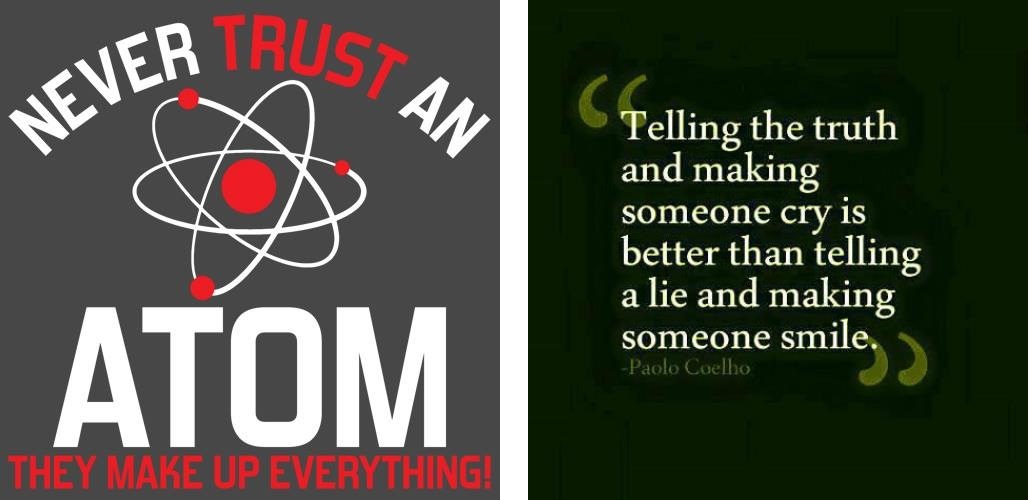
We interrupt this program to bring you an important musical and meme message!

atoms-feelings-truth

In the fields of neurology, pathology, endocrinology, genetics, linguistics, psychology, sociology, even philosophy — is there an interdisciplinary term for these(?) — do these areas perpetually interact or are they completely self-sufficient, self-reliant?

With chemical interactions, many if not most are well understood and predictable, until we humans or the environment create new ones. With human interactions, some… if not more or less… are well understood, until someone or others invent new ones. When these unexpected creations occur, and they inevitably do, how should they be received? Received with instantaneous conclusions or judgements, or with reservation, patience, and time in order to account for margins of error? Perhaps with elements of both? Is there a time to speak your results or a time to quietly wait, to consider, and reconsider? It has been my personal experience that TIME… typically more than what I first imagine, is the wise policy. A policy to suspend or allow for the learning-curve, if for no other reason than to remind myself that in order to gain improved interactions, human or otherwise, this policy also allows for the greatest of virtues and bonds to flourish.

To my readers and followers, what are your thoughts and experiences with interactions and bonds… atomic, chemical, or human? Please share them!

Live Well — Love Much — Laugh Often — Learn Always

(paragraph break)

Creative Commons License
This work by Professor Taboo is licensed under a Creative Commons Attribution-NonCommercial-NoDerivatives 4.0 International License.
Permissions beyond the scope of this license may be available at www.professortaboo.com/contact-me/.

Stay or Go?

(paragraph break)

Nothing is so dangerous to the progress of the human mind than to assume that our views of science are ultimate, that there are no mysteries in nature, that our triumphs are complete and that there are no new worlds to conquer.
Humphry Davy

(line break)

My youth soccer head coach obviously didn’t want me to leave our U-17 team or the south Dallas league in which I had played the last eight seasons accumulating notoriety, awards, and trophies both for myself, him, and the team. But the fact remained:  in 1980 the OCSA paled compared to the NDCCCL of north Dallas-Plano. In south Dallas I was only a semi big fish in a small pond. I knew too well that if I were to have a chance to play at the highest levels possible, I had to travel over 20-miles there and back, 2-3 times a week and every weekend where the top flight players, teams, and coaches were competing; it had to be done.

If my parents and I had listened to many of the naysayers, I wouldn’t have achieved a sizable college soccer scholarship, been mentored and coached by two world-class former pro goalkeepers, started all four collegiate years, awarded MVP and All-Tournament Team in the 1982-83 NAIA National Championship tournament, awarded one NAIA Honorable Mention All-American (sophomore year), one NAIA second-team All-American (junior year), and two first-team All-American awards by the NSCAA and NAIA my final year, then I likely could not have gone on to a rewarding pro and semi-pro career the next 11-years on three foreign continents then back to the U.S., retiring in 1996.

I can gratefully and humbly say through firsthand experience that sometimes (many times?) the rewards are so worth the risks.

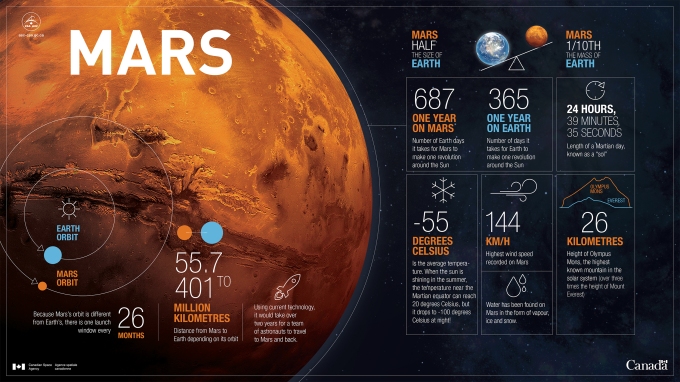
In the course of human endeavors of progress, better understanding, advancement, and evolving and promoting our species, we have reached another crossroads:  interplanetary exploration and colonization. Mars. Should we do it? Should we stay put or should we go?

Because of the upcoming 6-part National Geographic Channel  series Mars premiering Nov. 14, 2016, I stumbled into an intriguing discussion with a good friend of mine about colonizing the nearby distant planet. Though he is a big Star Trek fan and all for space exploration, my friend had some valid points. Here’s how the banter went:

Friend:
A crappy Earth with problems would be better than Mars, Moon Colonies, etc. The only viable solution is a nearby habitable planet very similar to Earth. If we had the technology to colonize & terraform, we certainly would be advanced enough to heal our own planet. There are too many things we are interdependent on to leave Earth behind just yet. Besides distance, even an Earth-like twin planet would have many hidden obstacles to colonization.

mars-by-the-numbersProfessor T:
Similar warnings were also given to Magellan, Dias, Drake, Vespucci, Pizarro, Erik-the-Red, Ulfsson, Herjólfsson, Zheng He, and several others. Why did they not listen? (wink)

Friend:
LOL! That’s nowhere close to being equitable. Not apples and oranges! Apples and iPhones! It’s not a warning, it’s simply thinking ahead. I am by no means well versed but I know enough that Space is even less hospitable than Mother Nature here on Earth. If you saw The Martian, read the book, then listen to the author as he explains in interviews what he had to extrapolate technology wise and fudge(!) just to make that story work.

Professor T:
Not really arguing your very valid points. But like the Serengeti wildebeests, gazelles, zebras, buffalos, etc, that annually cross the Grumeti River which they all know is FULL of hungry happy crocodiles and almost certain DEATH… yet they cross it, and many/most of those migrating animals cross multiple times in their lifetimes! Now explain to me why it is human nature and animal nature to constantly take risks, including paramount life-threatening risks!? (wink)

Friend:
You are definitely from the Berenstain Bears timeline.

Professor T:
Bwahaha! Are you implying that I enjoy children’s storybooks and such pleasure might reflect a similar intellectual capacity!!!!? Then if so, you’d be correct Sir. (wink)

Friend:
Ha, ha! No, it’s a “thing”. Google Berenstain/Berenstein Bears, Mandela phenomenon, etc. I’m just joking though.

Professor T:
By the way, as you know, I loved The Martian! Haven’t read the book yet, but the film was excellent!

Friend:
If you lived closer, I’d let you borrow my copy.

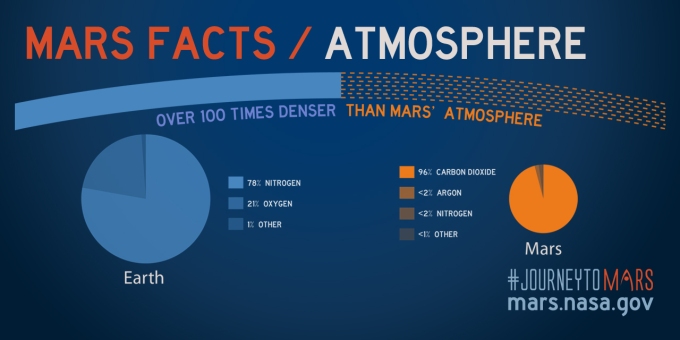
atmosphere-mars-facts

from NASA’s website http://mars.nasa.gov/

The history of human exploration is indeed littered with many failed expeditions, fatalities and disasters. Perhaps the more notable ones just on Earth were The Narváez Expedition (1527), Hudson-NW Passage Expedition (1610), The Reed-Donner Party (1846), The Franklin Expedition (1845), and the 1996 Mount Everest Party to name just five. Moving out from Earth we have the doomed space disasters of several Russian Soyuz flights, NASA’s Apollo 1 (1967) and near disasters of Apollo 13 (1970) and Gemini 8 (1966), the 2003 Colombia Space Shuttle, and of course the 1986 Challenger Space Shuttle. Why haven’t we learned that stepping outside of our cozy, known (safe?) comfort zones could turn into a debacle or fatal tragedy? What is our malfunction? (laughing)

Is there really a need for further space exploration and interplanetary colonization at the risk of more deaths? Why or why not?

(paragraph break)

Live Well — Love Much — Laugh Often — Learn Always

Creative Commons License
This work by Professor Taboo is licensed under a Creative Commons Attribution-NonCommercial-NoDerivatives 4.0 International License.
Permissions beyond the scope of this license may be available at www.professortaboo.com/contact-me/.

Origins and Orthodoxy

The six of us were all sitting around the kitchen table discussing time-travel and the effects of gravity on time itself. A good friend of the family repeated once again what she had stated earlier, “It is all merely philosophy and theory.” The word speculation would probably have been another word she would have approved and used. My political and respectful(?) response was “But how will we learn and know if we don’t GET OUT THERE and collect the actual data?” She agreed.

You see, our sweet good friend comes from a long maternal ancestral line of Protestant evangelical fundamental Christian indoctrination. She has not known any other lifestyle or worldview her entire life of 32-years. Because of this and also where I currently reside — the Hill Country towns of central Texas and nearer a few of my extended family — I am confronted daily or weekly with this religious mindset and way of life which they automatically assume to be true and right from generations after generations, after generations. I ask… should we not get out there, explore, examine, scrutinize, and always ask the hardest questions in order to arrive at the most plausible truths? I think so.

From 1983 to 2002 “getting out there” was exactly what I set out to do regarding a real God, the Christian bible, then the Hebrew bible, and more recently the Quran. This post and some of my other related blog-posts are what I discovered over those 19-years and counting. This post is another condensed study and research from those years based on 20 scholars listed in this supporting Bibliography Library-Page, as well as my personal experiences with fundamental Christian evangelists, extended family, apologists and one particular Hindi futeboller from Kashmir, India. My purpose for writing another post about biblical fundamentalism, particularly Christian, is simple. Share with the public and anyone interested just how few questions are asked about the roots of earliest Christianity under the contextual dominance of the early through late epochs of the Imperial Roman Empire. It is safe to assume that mainstream Christianity, if not church leadership too, are naïve of their own faith’s history and origins.
(line break)

* * * * * * * * * *
(line break)

The Nature of God?

How does a person learn who God is, what She/He/It is like, and how do we know it is truly God and not some imposter or auditory or visual hallucination? This question of course presupposes that a God exists in the first place. Ignoring this a priori step in the process of logic and reasoning would be a serious mistake. However, for the sake of time and subject matter, I will not go into the existence or non-existence of God. For a plethora of reasons much of the world believes God or a Supreme Being exists anyway.

Therefore, assuming a God(s) does exist, how can we know this God? Morgan Freeman’s recent National Geographic mini-series The Story of God was pretty well received by audiences and critics as Freeman and his team traveled the world gathering various cultural perspectives of God. I Google-searched the question “How can we know God?” and it returned these first 10 resources, out of about 483,000,000 results:

“How to Know God Personally —

What does it take to begin a relationship with God? Devote yourself to unselfish religious deeds? Become a better person so that God will accept you?

You may be surprised that none of those things will work. But God has made it very clear in the Bible how we can know Him.

The following principles will explain how you can personally begin a relationship with God, right now, through Jesus Christ…”

(from the Campus Crusade for Christ International website)

From the Joyce Meyer Ministries website “Everyday Answers”…

“There was a time in my life when I struggled with all types of fears and insecurities, constantly worried about the future, my job, my ministry, and my family. Needless to say, I wasn’t really enjoying my life!

However, over time, the Lord helped me to change… and He helped me understand an important key to truly enjoying life. It all begins with what the apostle Paul says in Philippians 3:10… something I believe we should all pray regularly…

“[For my determined purpose is] that I may know Him [that I may progressively become more deeply and intimately acquainted with Him…understanding the wonders of His person more strongly and more clearly]…” (AMP).”

From the Got Questions Ministries website

“How can I get to know God better?” —

Answer: Everyone knows that God exists. “God has made it plain” that He is real, “for since the creation of the world God’s invisible qualities—his eternal power and divine nature—have been clearly seen, being understood from what has been made, so that people are without excuse” (Romans 1:19-20). Some try to suppress the knowledge of God; most try to add to it. The Christian has a deep desire to know God better (Psalm 25:4). — by J.I. Packer

(the next 7 paragraphs reference the Christian bible 13-times)

From the In Touch Ministries website

“Getting To Know God” —

Did you know God wants to show you more of Himself every day? Does your time with the Lord revitalize you, or does it feel more like a ritualistic experience? In Hosea 6:6, God is clear: “I delight in loyalty rather than sacrifice, and in the knowledge of God rather than burnt offerings.”

(the next 6 directives reference the Christian bible 3-times)

From the Every Student website

“What does it take to begin a relationship with God? —

Wait for lightning to strike? Devote yourself to unselfish religious deeds? Become a better person so that God will accept you? NONE of these. God has made it very clear in the Bible how we can know Him. This will explain how you can personally begin a relationship with God, right now…”

(the rest of the page references the Christian bible 16-times)

And jumping to the 10th result on the Harvest Ministries website

“Know God —

You were created to know God in a personal way—to have a relationship with Him, through His Son, Jesus Christ. How do you start a relationship with God?”

(the following 4 step procedure references the Christian bible in every step)

peggy-and-godNoticing the pattern? The bible, the bible, the bible, and repeatedly the bible apparently has all the answers to knowing God. There doesn’t seem to be any tangible physical meeting of God where you actually see God, or hear Her/His/Its voice, you cannot call God up for an interview, nor is there a global standard of where to find God or how to find God’s collective global nature from any of these websites… except, in the Bible.

This has been my own experience when asking faith-followers these questions about God. In other words, the more people asked, there seems to be more than just one simple version of God! Hmmm. Maybe what should be asked is what “version” of God is most popular in the world?

According to www.Adherents.com and other sources, the world’s largest religion by population is Christianity (2.1 billion), followed by Islam (1.5 billion), then the Non-religious or unaffiliated (1.1 billion), Hinduism (900 million), Chinese Traditional (394 million), and Buddhism at 376 million respectively. As a result of popularity then, let’s look more closely at the Christian version of knowing God. How can it be done?
(line break)

Divine Revelation?

Throughout the lore and archaeological evidence of humans, when a divine spirit or Supreme Beings disclosed themselves to people, or something about existence, or about the world, in theological terms that is often defined as revelation. Because video and audio technology did not exist 50,000 years ago when forms of verbal human language began, and institutionalized morality only began long after around 10,200 BCE in the Neolithic Period, we cannot know the types of divine revelations that took place. Prior to the start of human writing (cuneiform) 5,000 years ago or around 3,000 BCE, there was still no video or audio technology available to literally record gods or God. Only rituals, song and dance, and oral traditions passed to descendants in various chiefdoms and tribes in ancient Egypt, Sumeria, and Mesopotamia were the way to know about God or gods.

Kesh-temple-hymn-tablet

Kesh Temple Hymn tablet

Today, one of the oldest known religious texts is the Kesh Temple Hymn from ancient Sumer which dates to around 2,600 BCE. Yet, other than Sumerian admonishments the hymn offers only glimpses and inference into their gods. The other oldest religious text — the Egyptian Pyramid Texts — was carved into the walls of the pyramids at Saqqarah and date to around ca. 2400–2300 BCE. However, these Egyptian texts do not reveal any specific ways to know the gods other than again by inference.

As a result of very very ancient oral traditions or storytelling, and very ancient cuneiform inferences, both from an area of the ancient world covering over 1.5 million sq. miles, how then do Christians today really know God? Are all of them experts in palaeography and epigraphy and their interpretations? Of course not. Do they speak regularly with those deceased Neolithic Sumerian, Egyptian, Mesopotamian storytellers, or ancient Hebrew, Arabian, or Greek orators? Of course not. It would be wise, therefore, to better understand what exactly it is and why Christians place so much unquestioning faith and belief in 1) a religion based on ancient storytelling, 2) widespread fluid (imprecise) cuneiform art, 3) a couple or three very small Hebrew tribes from the ancient Middle East, and followed by 4) more letters and stories about a man’s life and teachings recorded 60 to 110 years AFTER the actual events occurred in the 2nd century CE.

Fertile Crescent

The Fertile Crescent

Yet, despite this precarious framework of revelation, a great number of evangelical fundamental Christians would disagree with my above assessment. Why?
(line break)

Special Communion

They disagree because they and apparently 2.1 billion in the world proclaim that God CAN be known. They disagree because God has made Herself/Himself/Itself available to be communed with through two or more methods. If anyone can list and explain more than these two methods, please feel free to share in the comments below! Nevertheless, take a large enough sample of those 2.1 billion Christ-believers — similar to hearing a complete sentence on the trading-floor of the New York Stock Exchange during heavy screaming — and one can start to narrow the methods down. I will borrow from Theopedia.com to explain…

  • General Communion/Revelation – “Also known as Universal revelation, general revelation deals with how God can be understood through his creation. More specifically, this can be manifest in physical nature, human nature, and history.
  • Special Communion/Revelation – “is distinguished from general revelation in that it is direct revelation from God. Examples include God’s direct speech to various people (e.g., prophets; cf. 2 Peter 1:20-21), the incarnation (cf. Hebrews 1:1-2), and the Bible. Such revelation is sufficient to communicate the gospel, unlike general revelation, and thus salvation is possible only through special revelation.

Is General Communion/Revelation adequate to authenticate evidence of a God as Christians claim from Romans 1:19-20? The controversy over this religious tenet versus human reasoning (science?) started way before 2nd century CE Christianity and as early as the 7th century BCE in Mesopotamia by Assyrian and Babylonian astronomers.

Total-lunar-eclipse-moonThe lethal controversy was over the purpose or reason for lunar eclipses. The Assyrian-Babylonian priests believed that lunar eclipses were evil omens and vindictive restlessness of the gods directed against their kings. However, due to hundreds of centuries of recorded astronomical data, by the 1st century BCE Babylonian astronomers knew an upcoming lunar eclipse would happen on May 28th, 585 BCE at sunset. In fact, their mathematical calculations were accurate within a couple of minutes! The astronomers had calculated the 18 year and 11.3 day (223 synodic month) interval between lunar eclipses. This suggested that the eclipses had a natural (scientific) cause. If lunar eclipses were predictable, then the Babylonians could appoint a temporary king (likely through coercion) who would accept the horrible wrath of the gods, thus saving the real king from a death-omen.

The most famous controversy of church tenets versus human reasoning and mathematics was between Galileo Galilei (1564-1642 CE) and the second organized Christian church, the Roman Catholic Church. As most already know, Galileo was tried and convicted as a heretic by the church for his correct Heliocentric system of our solar system. It made no difference though, God’s Holy Church and Testaments infallibly ruled. It wasn’t until over 350 years after Galileo’s death that the church addressed their ‘mishap‘:

“… Pope John Paul II gave an address on behalf of the Catholic Church in which he admitted that errors had been made by the theological advisors in the case of Galileo. He declared the Galileo case closed, but he did not admit that the Church was wrong to convict Galileo on a charge of heresy …”
National Center for Biotechnology Information, October 1992

Therefore, given that the physical world has not and cannot be wholly described at a moment in time as monistic evidence, or substance monism/Neoplatonism, for evidence of God — i.e. one creation by one source during the sixth day of creation while new species are being discovered and others going extinct every decade or century — this leaves us with only Special Communion/Revelation to know God.

As stated by Theopedia and most Christian-believers, Special Communion/Revelation is their firm foundation for knowing and experiencing the Judeo-Christian God. This communion has three components:

  1. Direct speech – through past and present prophets carried by the Holy Spirit (2 Peter 1:20-21).
  2. The Incarnation – through the birth, life, crucifixion, and resurrection of Christ (Hebrews 1:1-2).
  3. Holy Bible – a communal collection of ancient writings breathed by God which comprise the sixty-six books of both the Old Testament and the New Testament.

For the sake of my reader’s time and mine, I will make brief comments on the first two special-revelation components which I hope will cause anyone to examine or reexamine their dubious implications. Following those comments we will finally delve into the origins and developments of the Christian Bible.

joshua-jerichoDirect speech
By popular definition prophets hear or sense the voice of God directly then obey. Innumerable documented examples reside both in ancient and modern history. About 1,550 BCE the prophet Joshua was told by God to go conquer the land and people across the Jordan River (Joshua 1:1-6), killing all the men, women, and children (Joshua 6:21). After Jericho was razed, on the further commands of God Joshua then razed the town of Ai, killing 12,000 men and women (Joshua 8:24-28). Genocide is not the only command by God either, mass suicide is also spoken by God to the more faithful zealous followers. At the fortress of Masada in 73 CE led by the apocalyptic prophet Eleazar ben Yair, though details are debateable, 960 Jewish revolutionaries committed suicide/murder for their God rather than endure enslavement by Rome.

Jones-Koresh

Jones (left) and Koresh

In modern history three iconic prophets also followed God’s direct speech for mass suicide of all their most faithful zealous followers. They do not need any elaboration here. They were Jim Jones in Jonestown, Guyana (Nov. 1978) of 918 followersnearly 300 were childrenMarshall Applewhite in Rancho Santa Fe, CA (March 1997) convincing 39 followers, and David Koresh in Waco, TX (April 1993) leading 85 followers — 22 of them children/teenagers — to their mass suicide/incineration.

In a 2007 co-authored article by Erich Follath (diplomatic journalist), Manfred Müller, Ulrich Schwarz (theologian), and Stefan Simons (Spiegel Online correspondent) entitled Following Divine Orders which focuses on the Age Old irresistible appeal of religiosity for fanatics, or rather those who are not moderate or “luke warm” about their beliefs:

“According to the three Abrahamic faiths, God only revealed the truth about Himself, humankind and the world to their respective religion; it is therefore recorded separately in their holy scriptures: the Hebrew Bible (the Torah, or Old Testament to Christians), the Christian New Testament and the Islamic Koran.

These [bibles] contain countless contradictions. Both the Koran and the Bible’s Old and New Testaments bear witness to a good and merciful God. They urge humans to live in peace and harmony. This is reflected most clearly in the instruction attributed to Jesus in the Hebrew Bible: “Love thy neighbor as thyself.

But these messages of brotherhood clash with sentiments that condone intolerance and violence: “For I came to set a son against his father, a daughter against her mother …“; “Anyone who loves his father or mother more than me is not worthy of me“; “Do not think that I came to bring peace on Earth. I did not come to bring peace but a sword.” The prophet Mohammed also delivered harsh threats from Allah: “Fear the fire prepared for the infidels.

Throughout history, the Abrahamic religions’ claim of absolute authority has exerted an irresistible appeal on fanatics, encouraging them to impose their own faith on nonbelievers and dissidents alike – if need be by using fire and the sword. To this day, nearly all religions supply the kindling that fuels wars and acts of persecution, sparks torture and murder, and inflames ethnic hatred. Examples abound: the bloody wars between Hindus and Muslims in India, or the enmity between Muslims and Christians in Indonesia.

For centuries, it seemed that the Abrahamic religions had come to terms with – and discarded – extremism. In the case of Christianity, this dates back to the Enlightenment, when the symbiosis between church and state collapsed and a new system of ethics emerged – one that was independent of faith in God and derived solely from social consensus.”

Those above examples of ancient and modern direct divine revelation seriously beg the questions What exactly is the Holy Spirit and how is it (a prophet) accurately tested for authenticity? Anyone who wishes to answer these questions, good luck! I do NOT envy you. There are as many various definitions of the Holy Spirit/False Prophet debate by Christians as there are species and sub-species in the animal kingdom! It is truly unimaginable. Suffice it to say here that almost all Christ-believers, scholars and laypersons alike, ultimately and exclusively refer to their Bibles for definitive Holy Spirit or non-Holy Spirit answers. Naturally, that only leads to more questions. Therefore, “direct speech” is not a religious consensus to really knowing God.

Greek-soccer-fans

Greek soccer fans

It is worth mentioning, the fields of psychology, neurology, and sociology have many theoretical studies associating heightened religious behaviour due to Temporal lobe epilepsy and minor forms of schizophrenia, and sociologists have found that social God-constructs can persuade individuals into states of euphoria because of large numbers of people acting together in a strongly shared belief — crowd psychology or mass hysteria, also known as Mass Psychogenic Disorder/Hysteria. Huge sporting events are good examples of this phenomena. Extreme isolation can have similar effects of hyper-religiosity and paranormal hallucinations, sometimes negative.

The Incarnation
In theological terms, this is simply God in and as Jesus Christ; both God and man simultaneously. The first grave problem with this Christian doctrine is that it is based upon only “Christian-biased” historical sources and traditions riddled with inconsistencies. In other words, who and what Jesus of Nazareth was historically between 6-4 BCE and 30-36 CE, the generally agreed upon lifespan, cannot be verified with absolute certainty outside of the Christian Synoptic Gospels. Many Christian apologists vehemently claim that writings by Flavius Josephus, Pliny the Younger, and Tacitus are non-Christian evidence for the historicity of Jesus. F. Josephus, however, was not completely unbiased about the new Jesus-Movement called The Way by Judean-Christians; he too was involved in 1st century CE Jewish Messianism as a Pharisee. Pliny and Tacitus were indeed Roman and non-Christian, but their very brief mentions are about Christians as a whole, rather than a biography about a specific person named Jesus.

Therefore, the best that Christian-believers can hope for regarding an actual verifiable incarnation of God through Jesus of Nazareth is by Christian scribes and followers 30-90 years after his death based on oral-storytelling traditions. That is the closest that honest scholarship can provide at this time, and beyond that is a question of individual faith within crowd psychology. This now leaves us only with the Bible… what the doctrines of Direct speech and The Incarnation frequently must reference anyway.
(line break)

The Canonical Bible

Many modern Christians are unaware of the origins, early development, and the 2nd and 3rd century CE controversies surrounding the final compilation of their Bibles. Some believers might even think their bible suddenly dropped out of heaven long long ago after God finished writing the 66 books, never thinking to ask “Why just 66 books? Why not 40 or 10 simple books?” And honestly, orthodoxed American society today, including many Christians, know very little of the ancient world of Jesus, the Levant, and the Fertile Crescent.

First_century_Iudaea_province

click here to enlarge

The birthplace of Jesus was Judea, the Jewish province ruled by Rome. Divided by intense religious factionalism, the people of Judea, as well as Galilee, Idumea, Nabatea, and Perea were anxiously awaiting the arrival of the Messiah and God’s salvation. First century CE Romans would have encountered a large mix of traditions and philosophies in this world. The Hebrews had for many centuries suffered foreign invasions and been harshly buffeted by powerful external cultural forces. The most potent of these was Alexander the Great’s Greek civilization supported by several centuries of Hellenistic overlords in Egypt and Syria.

The Jews in these regions were divided over subjects ranging from the legitimacy of the priesthood to the acceptance of certain books into the Hebrew Canon. The Essenes rejected the priesthood entirely. Samaritans formulated their own unique doctrines. Various cadres of Jewish zealots pledged themselves to the expulsion of the Romans. Sadducees made up their prestige with the aristocratic clans making up the priesthood in Jerusalem and exclusive supervision of the Temple. They rejected the books of the Prophets and Writings and also became more ingratiated with Herod and Roman governors who eventually granted them local rule in the Sanhedrin. The Pharisees were more progressive than the Sadducees in that they not only accepted those books, but also believed in angels, demons, resurrection, and — like the Essenes and other groups — passionately in the coming of the Messiah, e.g. the Apostle Paul. The Pharisees also had grown a body of unrecorded commentary on Hebrew Scriptures and rulings by Jewish sages. This was intended to help Jews adapt the ancient Law of Moses to the circumstances of their own time.

Essentially, roots of the Christian New Testament began during this period of great Jewish disunity, alienation, isolation, and confusion before anything Christian was written down. Once Christ-followers began recording an anthology or testaments of Jesus’ parables, prophetic and wisdom teachings, and exhortations — by around 150 CE (over a century after Jesus’ death) — there was no less than 42 testaments or gospels for Christian teachings which were freely circulating as opposed to just 27-books in today’s New Testament. The formulation of the Hebrew Bible, i.e. the Old Testament, went through similar reconfigurations between 500 BCE and 70 CE, i.e. approximately 600 years!

Naturally, all this diversity and variety of who and what the Nazarene was caused more confusing fractures among outlying Christians and Judean-Christians for centuries! It is like trying to answer What is an American?” today in one single description from 324+ million citizens. To learn more about the various origins of Nazarene-Nasorean-Nasara-Nazirite, go here to my bibliography subpage: The Nasara-Nazirites.

map_Roman-Empire_14-117CE

1st & 2nd century Roman Empire

Authoritative or Not Authoritative? 
For over three and a half centuries (between 337 and 389 years!) after Jesus’ death, there existed no standardized written collection about Jesus’ ministry or precisely what he did or taught. Everything known about him (and not known) was by word-of-mouth across 2,000 sq. miles. What is more dubious and astounding is that what little there was written down about Jesus’ message was by a foreigner, a Hellenistic Pharisee named Saul of Tarsus who had never once met Jesus in the flesh, in person. No surprise, after Saul’s ‘paranormal conversion‘ to “The Way” on the road to Damascus, he fell into serious conflict with the Council of Jerusalem headed by Jesus’s next-in-line brother James, Peter, Cornelius, and other Judean-Christian leaders who had personally known Jesus quite well compared to Saul. Yet, today Pauline-Christianity (aka Saul) predominates the New Testament, seminaries, and modern churches. James Tabor, professor in the Department of Religious Studies at the University of North Carolina at Charlotte, writes about this heavy influence from a near total stranger to the Jerusalem leaders… and their and Jesus’ Neo-Jewish teachings. Tabor states:

The fundamental doctrinal tenets of Christianity, namely that Christ is God “born in the flesh,” that his sacrificial death atones for the sins of humankind, and that his resurrection from the dead guarantees eternal life to all who believe, can be traced back to Paul — not to Jesus…

In contrast, the original Christianity before Paul is somewhat difficult to find in the New Testament, since Paul’s 13 letters predominate and Paul heavily influences even our four Gospels. Fortunately, in the letter of James, attributed to the brother of Jesus, as well as in a collection of the sayings of Jesus now embedded in the Gospel of Luke (the source scholars call Q), we can still get a glimpse of the original teachings of Jesus…

What we have preserved in this precious document is a reflection of the original apocalyptic proclamation of Jesus: the “Gospel of the kingdom of God” with its political and social implications.
Christianity Before Paul, The Huffington Post, November 2012 cited Aug. 16, 2016 at http://www.huffingtonpost.com/james-d-tabor/christianity-before-paul_b_2200409.html

With this and other additional alternative extant evidence, one has to ask “What formula was used some 300-years later to configure and reconfigure the vast oral and written testaments/gospels of Jesus?” Hitherto is a list of the most significant testaments/gospels about Jesus of/the Nazareth/Nazarene out of approx. 130 known writings not present in the New Testament today:

Non-Canonical Writings (Incomplete)

For a more complete list of the many known writings of Jesus and his earliest followers, go to the NNU Wesley Center’s page of Non-Canonical Literature.

(paragraph break)

Apostolic Fathers and the Canon Formula

Signs that much of these various Jesus-literatures had been accepted as authoritative by church leaders and early Christian congregations as early as the 1st and 2nd centuries CE appear in the letters of the Apostolic Fathers. During these centuries of the new upcoming churches, no official creed or universally accepted liturgy existed. In the following paragraphs, notice the similarities from the first churches to modern-day Christian churches.

The biggest and most heated controversy was a newer version of an old Jewish sectarian problem:  Are the Hebrew Laws, Prophets, and Writings above, below, or void in light of Paul’s Hellenistic teachings — deeds or faith? Another ongoing spinoff debate was the Gnostic challenge:  There are two dualistic worlds and two Gods, and there was no Incarnation, explained as follows:

  • The World of Darkness was created by an inferior God, the Hebrew God, and so the Hebrew scriptures were rejected or severely de-emphasized.
  • Material aspects of this Dark World, including the human body, were burdens that humanity was forced to endure by the Hebrew God.
  • The World of Light and Knowledge was ruled by a Supreme Being. Salvation was possible only through gnosis of this divine world and the Supreme Being’s mysteries, but salvation was available only to some, not all. Some Gnostics had a three-tiered class system too.
  • There was No Incarnation because he was not the Son of the inferior Hebrew God, nor did he become a man, suffer human pain, or die on a cross. Resurrection was merely a spiritual linking of the soul with the World of Light and had nothing to do with a human body.

Because Pauline Orthodoxy had the support of Rome, Constantinople, Alexandria, and Antioch, and their power and influences of those churches and bishops, by the 4th century CE the Gnostics would quickly be labelled heretics and harshly hunted down and most all their holy literature burned. With the four strongest episcopal sees in the Roman Empire, Ignatius, Clement of Rome, Polycarp, Hermas, and their colleagues along with their heavy power and influence… the weaker episcopal sees around the Empire and the remaining Jewish-Christians in and around Jerusalem simply could not stand up to the might of Hellenistic Constantinian Rome.
(line break)

Victors and Emperors Always Make the “Authoritative” Laws and Histories

Walter Benjamin posited that “History is written by the victors.” Historical records of major social, national, economic, ethnic, or religious upheavals and cleansings bear this philosophy out to some/large degrees. And so with his maternal-influenced-miracle-based sanction of the “official” Christianity, Emperor Constantine not only led the Roman Empire, but was also Head (Pope?) of the Church. He called for unity as a whole within the Church and agreement on its scriptures. Easier said than done inside one of history’s largest empires.

There were no less than seven failed attempts to form an official universal Bible. On the eighth failed attempt by Eusebius of Caesarea at the request of Emperor Constantine, Eusebius’ rejection of the popular Gospel of Peter, Gospel of Thomas, Gospel of Matthias; the Acts of Andrew, of Paul and of John; the Shepard of Hermas, the Epistle of Barnabas; the Didache, 1 and 2 Clement; and the Apocalypse of Peter… got his configuration rejected (see Table of Canonical Debate below). His reasons for classifying certain texts as questionable or spurious had revealed the basic formula for inclusion. Probably more important for him was a writing’s perceived apostolic authorship, though its antiquity and orthodoxy were also of significant consequence. Study closely the following table…

Table Canonical Debate

Athanasius of Alexandria wrote his Easter letter to the churches and monasteries in his diocese identifying the books they were to include in the testaments. Athanasius was one of the more flamboyant patriarchs. He was exiled from his pentarchy five times leading back to the Council of Nicaea due to his unyielding defense and decisions to compromise with other Roman patriarchs (which at times included Eusebius) over controversial points of Christian doctrine. His canon had been later confirmed by the church in Rome in 405 CE, in 393 at Hippo Regius in North Africa, and in Carthage twice, in 397 and then again after the growing Gnostic churches in 419 CE in reaction to the intensifying debate regarding James, Jude, and Hebrews. The Syrians used the Diatessaron as their canon for another 50-years. The Ethiopian church continues to this day to recognize a book of Clement and several other non-canonical books of liturgy. Though the various pentarchy churches had made ground toward unity, it is important to know they were never in absolute agreement on the New Testament canon and Christian doctrines.

Notice from the above Table how even the seven Patriarchs, who were themselves understudies to the Apostolic Fathers, after 300 years still did NOT completely agree on what God’s Son, the Messiah, and the new and old messages was suppose to mean to all people. Yet Constantine, his bishops, and propraetors had to have orthodoxy — a long standing Greco-Roman political tradition.

It wasn’t until around 400-419 CE and centuries of compromise and more compromise that the final configuration of the Christian New Testament was officially closed — closed by the declaration of the Emperor, put into law, and enforced by the torches and swords of his Roman Legions. For a God who is proclaimed as omnipotent, omniscient, and infallible, and whose traits are “proven” in the special revelations of the Canonical Bible, raises the glaring question:

Why was there three centuries of confusion, fracturing, and compromise among its early most prolific theologians… and even still to this day!?

(line break)
For Jews and Christians alike, study of the Scriptures has often been an end to itself — a simple act of devotion — rather than an exercise in absolute truth. These peaceful moderates likely realize today that human interpretation, interpolation, and orthodoxy (individual or group) cannot create an inerrant testimony of the nature of a God, nor of the full nature and teachings of a Jew named Jesus based from ancient oral traditions and differing literature spread over multiple centuries… or from differing regional cultures over 2,000 sq. miles. From an early date, believers then also began to scrutinize the Bible for what it had to say to their own generation and community along with their prolific leaders. Exegesis back then was done for purposes of preaching, pastoral care, formulating codes of behavior, and finding answers to theological and ethical questions not explicitly addressed by the texts.

As it happens today, inevitably back in Antiquity, disagreements arose — over importance of texts, their relative authority to the community, how to account for known inconsistencies and contradictions, and how to explain confusing biblical stories. Like our dear family friend in the kitchen at the beginning, both sides of the debates were probably saying to each other, “Your posture is all merely philosophy and theory.” But orthodoxy nonetheless developed, often based on a pseudo-definite set of human-like rules or patterns regarding multiple meanings and levels of meaning. To imagine there to be just one universal way, one universal lifestyle, one universal truth (e.g. John 14:6), one universal orthodoxy extracted from these millenia of “divine revelations” then and now… is not only an attempt to force a square peg into a round hole, but it is a blatant denial and/or ignorance of historical facts, wide-ranging scholarly critical thinking, reasoning, and probability, and/or a lack of deeper persistent curiosity.
(line break)

Or it could be only tunnel-vision “faith.” Right? (wink)

(paragraph break)

Live Well — Love Much — Laugh Often — Learn Always

Blog-posts for additional information:

Constantine: Christianity’s True Catalyst/Christ
The Suffering Messiah That Wasn’t Jesus
Correcting the Gospels of Jesus
Masada, Texas: How Egos and History Repeat
The “Holy” River

Creative Commons License
This work by Professor Taboo is licensed under a Creative Commons Attribution-NonCommercial-NoDerivatives 4.0 International License.
Permissions beyond the scope of this license may be available at www.professortaboo.com/contact-me/.