It might be a tiny consolation to intelligent college-degreed Americans that tRump did not win decisively the U.S. popular vote Nov. 8th. As of 12:45pm CST today it was 48% to 48%. But that will not change what has begun happening for the next 4-years.
Let me first preface my initial thoughts. I am a political Independent who thoroughly evaluates ALL candidates and their background, experience, and track-record. I pay no attention to public campaigns and even less attention to the media-TV propaganda circus. Using websites like ProCon.org and other non-profit 501(c)(3) nonprofit nonpartisan public charities that provide well-sourced pro, con, and related research enabling what I think are very well-informed decisions. That said…
If you thought Hillary Clinton’s blunders in Washington D.C. were indications of serious character flaws for the Oval Office or how well or poorly to handle affairs in our nation’s capitol, on Capitol Hill, and out in the daunting international arena… we have just elected an immature 70-year old racist-misogynist with 1) a less-than-poised-mouth President, 2) with absolutely NO GOVERNING EXPERIENCE WHATSOEVER running the affairs of one of the world’s biggest, most influential nations in 3) extremely diverse global affairs with 4) a Congress that Constitutionally controls one-third of the total power between the three branches — 5) which is an entirely DIFFERENT beast than the private sector — of which 6) this man also has ZERO EXPERIENCE doing, ever!!! Now riddle me that!?
At least our Constitutional checks and balances are one more consolation for me and most definitely for our foreign allied nations and neutrals that are in as much dumb-founded shock as I am.
I like to consider myself a calm, reasonable man with above-average capability for critical-thinking skills, appropriate de-escalation methods — from my years in the Psych/A&D and Crisis treatment field — college-degreed with additional 18-hours graduate studies, and a deep passionate fondness for history and social sciences resulting in 5-years of general and Special Ed public teaching. This is why I have a high respect and admiration for retired 4-star general and former Secretary of State Colin Powell. He is the consummate embodiment of stoic diplomacy coupled with first-hand experience in war and world conflict. What I admire most about the esteemed Colin Powell is how he conducted himself during America’s most polarized tumultuous times: Vietnam, the invasion of Kuwait & subsequent First Iraqi War, and 9/11. If those three “tests” were any indication and model of how to manage diplomacy, politicians, and the dynamics of crisis, then Powell passes with stellar excellence! Magna Cum Laude, if you will. Two of many of my favorite Colin Powell quotes…
“Experts often possess more data than judgment.”
“Avoid having your ego so close to your position that when your position falls, your ego goes with it.”
What is further mind-boggling to me is that Colin Powell, though technically a Moderate, aligned himself politically with the Republican party — why was the G.O.P. unable to find anyone in 2014-16 resembling or somewhat-resembling the experience and exemplary poise of Powell(?), even someone with just HALF of his Capitol Hill savvy anywhere in this nation of 325-million!? Here is a very good Sept. 2016 New York Times article by Michael Shear about what Powell thinks of our two main Presidential candidates (Click here). I think Powell is spot on, knows what he is saying, and has the experience to back it up. Period.
Finally, what I will never be able to wrap my head around is how an American “democracy” gave tRump enough support (only 48%) to cause our Electoral College to actually put this no-experience-whatsoever man into the White House. Maybe this short video will help explain to the rest of the world how this happened. Click the link below…
Or maybe that doesn’t help at all and only confuses our allies and neutrals.
I do know this for those of you in foreign countries, those delegates in the Electoral College are our previously elected House Representatives and Senators from our 50 states, who are representative of our state’s two bipartisan parties and lesser extent third parties. But these “delegates” don’t get into office without being first elected by registered voters in their respective state. In other words, some/much of what happens or doesn’t happen on the Federal level hinges on what informed, or less-informed, or ignorant registered voters do and don’t do (i.e. active, inactive, or unregistered voters) on the municipal, county, district or precinct, and state levels FIRST!
Ultimately, there are only six groups to praise or blame for the U.S.A.’s political Electoral College success or failure (e.g. Abraham Lincoln and Richard Nixon, respectively):
Well-educated, well-informed registered ACTIVE voters
Naturally, the origins and causes of the above six American groups are an entirely different discussion and personal blog-post for which I currently have no desire nor energy to write. But hey, we all now have 4-years to think about and deal with it. This is the bed we’ve made for ourselves, now we must sleep in it. — says with sad dejection —
There are many many subjects I know nothing about; nothing of real significance that is, other than vague generalities and oversimplifications. For instance, I’m clueless about architecture and how to read a blueprint. I’m clueless about farming and how or when to plant certain crops, how to keep up the soil, when to harvest, etc. I’m also clueless about rugby or cricket and their rules! I’m clueless on how best to perform medical operations; I’m not a board certified doctor! There are many subjects I just don’t know enough about to carry-on any type of extended intelligent conversation!
So here are my questions to the cyber-world:
Is it wise to speak overtly, to be long-winded about things one knows very little or nothing about?
Why is it every two & four years — the American political cycle — everyone knows EVERYTHING about the dynamics of governing 319-million diverse people, or in my state of Texas 27-million, and are suddenly experts on ALL factors that effect people’s needs and wants and their current and future well-being? How do they have all the solutions!? What’s their secret? I want to know!
And now for some comic relief with much “truthiness”… 😀
(paragraph break)
Live Well — Love Much — Laugh Often — Learn Always
What is excessiveness? The dictionary defines it this way: exceeding a normal, usual, reasonable, or proper limit. Historians have sometimes defined it as out Herod Herod. Lord Salisbury in Shakespeare’s King John perhaps described it better as painting the lily:
Therefore, to be possess’d with double pomp, To guard a title that was rich before, To gild refined gold, to paint the lily, To throw a perfume on the violet, To smooth the ice, or add another hue Unto the rainbow, or with taper-light To seek the beauteous eye of heaven to garnish, Is wasteful, and ridiculous excess.
Every single human being requires a handful of necessities: water, food, climate-control, and shelter. To what extent or elaboration those four basic needs are fulfilled, can be averaged at any location, and thus a global standard can be determined. One and perhaps a minimum of two of these basic life-needs are in finite supply and crisis on our planet.
Fair warning for those who are sensitive to or bothered by grim facts of nature, our planet, and other human groups, self-discretion should be considered. What follows, in my opinion, needs to be at least made aware and considered by everyone on Earth.
(paragraph break)
* * * * * * * * * *
What do you think would happen if when you turned open your faucet and nothing came out? How long could you survive without water? Now, what do you think would happen if your entire city was without water or operating sewage? What would happen if a nation lost its water and sewage? There is no water to feed crops or gardens; no clean water to drink. Are you getting the picture? If not, let’s hear the alarming projections some scientists, scholars, and professional experts are reporting. Sorry this alarming documentary is an hour-and-a-half long, but it needs to be shared:
If you still feel this is not a problem for you and your children and grandchildren, you should have your ears examined. If you feel resource conservation is a form of socialism or communism, then you are in delusional denial.
Excessive opulence or resource hoarding is no different a global footprint than spending or consuming recklessly; they both accomplish the same singularity: proportionate risk. The more excessive, the more risk; the more risk, the more excessiveness to avoid it. As a species, if not as Americans, we need to…no, we must greatly refine our life-ambitions and the education of those ambitions and their purpose.
But let’s pause a moment and analyze where most Americans have headed since 1870 and are currently heading.
1870 – 1900: The Gilded Age
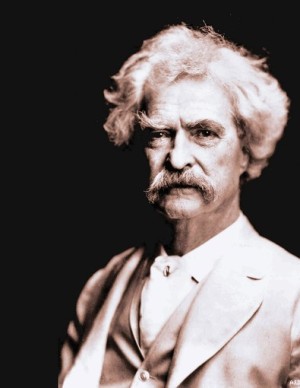
Mark Twain
Much pride and boasting has been made of America’s age of industrialization, that it was the catalyst that put the nation in the same discussion of the world’s greatest empires. Yet of our nation’s 12-million families then, 11-million earned less than $1,200 per year; of this group the average annual income was $380, well below the poverty line. In today’s CPI dollars (the purchasing power of goods and services produced in the 1890 economy) that is $9,890 per year per household. In his book The Gilded Age: A Tale of Today, Mark Twain wrote of the day’s barons and tycoons, “What is the chief end of man?—to get rich. In what way?—dishonestly if we can; honestly if we must.”
Though pre-1920 U.S. economic reports are less comprehensive as post-1920, Benjamin Schwarz of the World Policy Institute and Executive Editor of World Policy Journal writes in his 1995 New York Times article “By 1890, the richest 12-percent of households owned about 86-percent of the country’s wealth.”
1890 – 1920: Progressive Era
The Roaring Twenties
In 1910 the average annual household income was $574 per year. In today’s CPI dollars that is $14,300 per year per household. During this era America’s top 1-percent owned about 40-50 percent of the nation’s wealth and the top 10-percent fluctuated around 70-percent until President Theodore Roosevelt began his anti-trust legislation and wealth redistribution via progressive taxation.
1920 – 1929: The Roaring Twenties
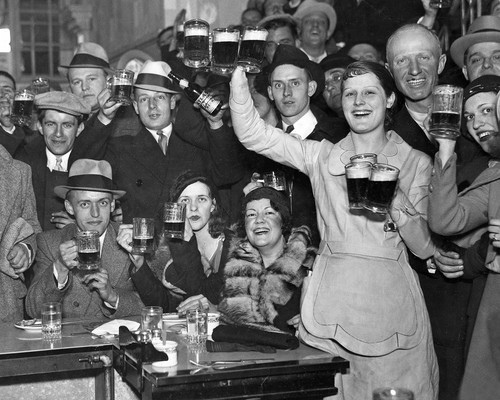
The average annual household income was $1,407 per year in 1920. In today’s CPI dollars that is $16,100 per year per household. In 1922 America’s top 1-percent owned 37% of the nation’s wealth; a slight change in years following Teddy Roosevelt’s administration. America’s middle-class indeed experienced a relative age of prosperity during the Roaring Twenties due to the automobile industry which fed industries such as oil, road-construction, tourism, manufacturing, and electric-power.
1929 – 1941: The Great Depression
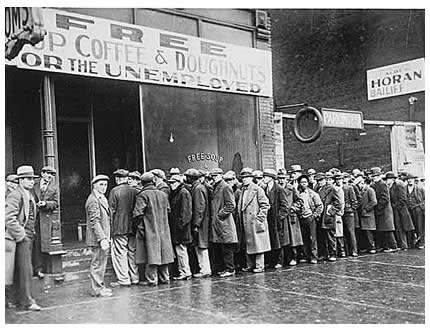
The average annual household income in 1930 was $1,388. By 1940 it had dropped to $1,315. In today’s CPI dollars that is $19,100 and $21,500 per year per household respectively. America’s top 1-percent in 1933 owned 33% of the nation’s wealth and 36.4% in 1939 demonstrated the upper-upper class comfortably rode out the stock market crash of ‘29. Unemployment for the nation’s middle class was at 25% and especially higher in heavy industries such as lumbering and agricultural exports in cotton, wheat, and tobacco. Fortunately, from a purely economic standpoint, another world war was on the horizon ready to put Americans, particularly women, back to work on a road to bigger prosperity than the Roaring Twenties.
1945 – 1973: Postwar Prosperity – The Golden Era
The average annual household income was $3,180 in 1950 ($30,300 in 2012 CPI) and $4,816 in 1960 ($37,300 in 2012 CPI), a significant increase in just 10-years. Middle-class Americans also enjoyed a bigger piece of the nation’s wealth: 70.2% in 1945 and 73% in 1949 while America’s top 1-percent saw their portion drop again to 29.8% and 27% respectively. Yet, it is this Golden Era that firmly placed the United States as a world power and dominant economy. As more and more Americans gained more wealth and more income, the nation experienced its most prolific prosperity to-date. How it happened will be examined shortly.
The American Dream. Notice the ethnicity?
When Dwight Eisenhower took office (1953-1961) the nation was going through another recession post-Korean War causing a decline in the nation’s GDP. This resulted in middle-America having less of the nation’s wealth over a 16-year period down to 65%, while America’s top 1-percent relished in increases back up to 34.4% of the nation’s total wealth in 1965.
By 1970 the average annual household income was $7,494 or about $44,300 in today’s CPI dollars; another notable increase in 10-years. As the Golden Era drew to a close and the Cold War and Vietnam festered, President Lyndon Johnson’s Great Society programs increased lower and middle-America’s wealth to 71% while America’s top 1-percent saw theirs fall to 29% of the nation’s wealth. However, hard times were just around the corner for most Americans.
1970 – 1976: Age of Stagflation
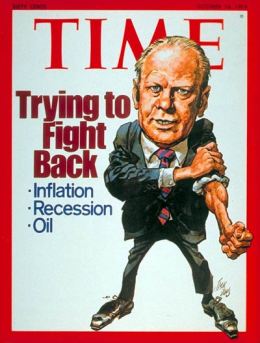
Image Time Warner
In 1973 the average annual household income was $9,037 or approximately $46,700 per household in today’s CPI dollars. The nineteen-seventies became known economically as the Age of Stagflation. The 25-year U.S. economic growth post-WW2 had stagnated to a crawl, and prices in goods and services rose annually in the double-digits from 10% in 1973 to 18% in 1979. Due to poor performances on Wall Street, America’s top 1-percent saw their share of the nation’s wealth drop to the lowest in history: 19.9%. Yet, middle-America enjoyed the highest ever share of the country’s wealth at 80%.
The eras of suburbanization in the 50’s and 60’s, however, had significant consequences in the 70’s. The migration of tens of millions of middle-Americans (most of them White), moving to newly developing suburban towns meant getting to work in cities went from public transit to private vehicles. This in turn caused America to become heavily dependent on foreign oil. The long-term varied ripple effect of suburbanization cannot be overemphasized, one of which is our bigger footprint on environmental and global issues.
1976 – 1992: Gilded Age Returns and Reaganomics
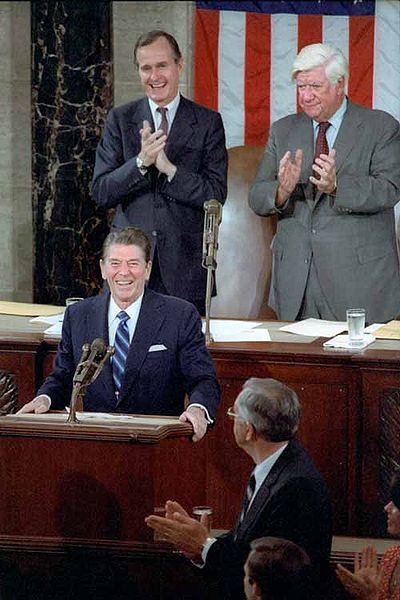
Reagan addresses Congress 1981 (Wikipedia)
From 1976 to 1988 the average annual household income was $11,080 or about $44,700 in 2012 CPI dollars – yes, a $2,000 drop from the previous 3-years – to $25,167 or about $48,800 in 2012 CPI dollars; just above break-even from 1976. To combat the stagflation of the 70’s, government deregulation along with personal and business tax cuts gained popularity. As it turned out most of the tax breaks, along with deregulating helped America’s upper-classes.
Additionally, defeats of labor unions – unions made possible by Teddy Roosevelt reforms with long histories of keeping big-businesses from corruption and abuse of workers – also fattened the pockets of America’s top 1-percent by going from 19.9% ownership of the nation’s wealth to having 35.7% by 1989. By 1992 the AAHI (average annual household income) was $28,870 or about $47,200 in 2012 CPI dollars; another drop from 1988. While middle-America struggled, the top 1-percent in America owned a rising 37.2% of the nation’s total wealth.
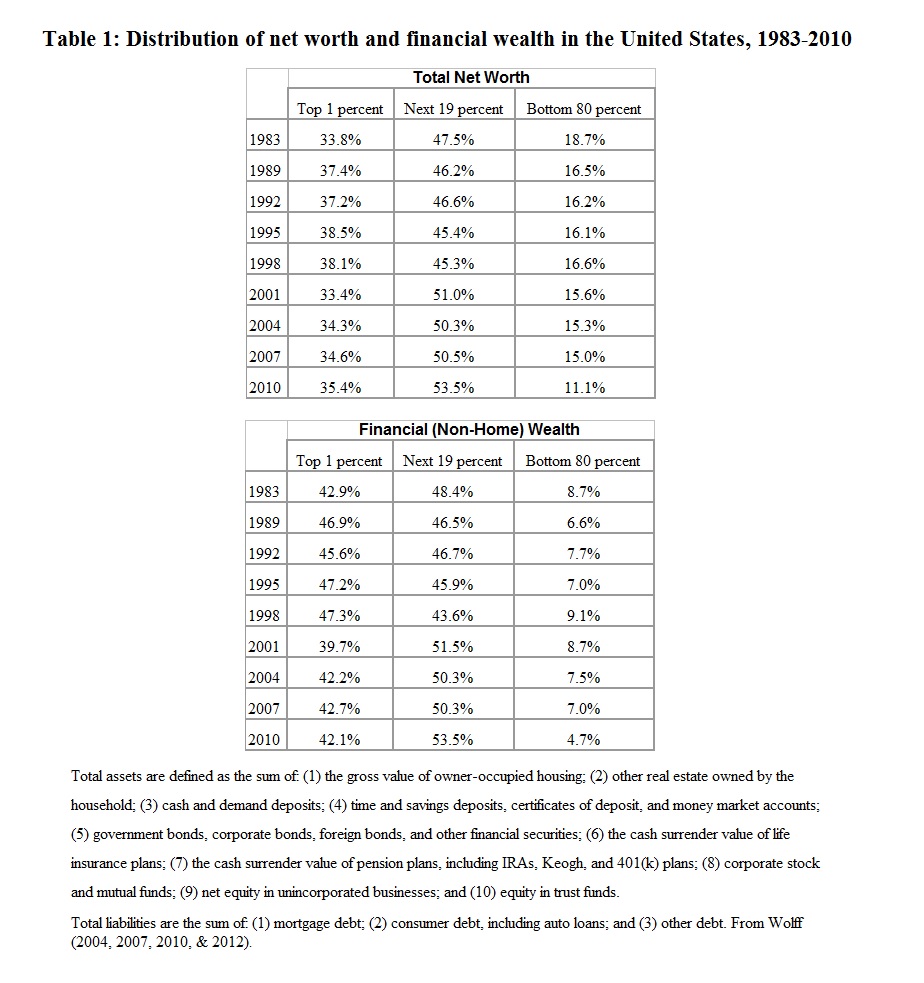
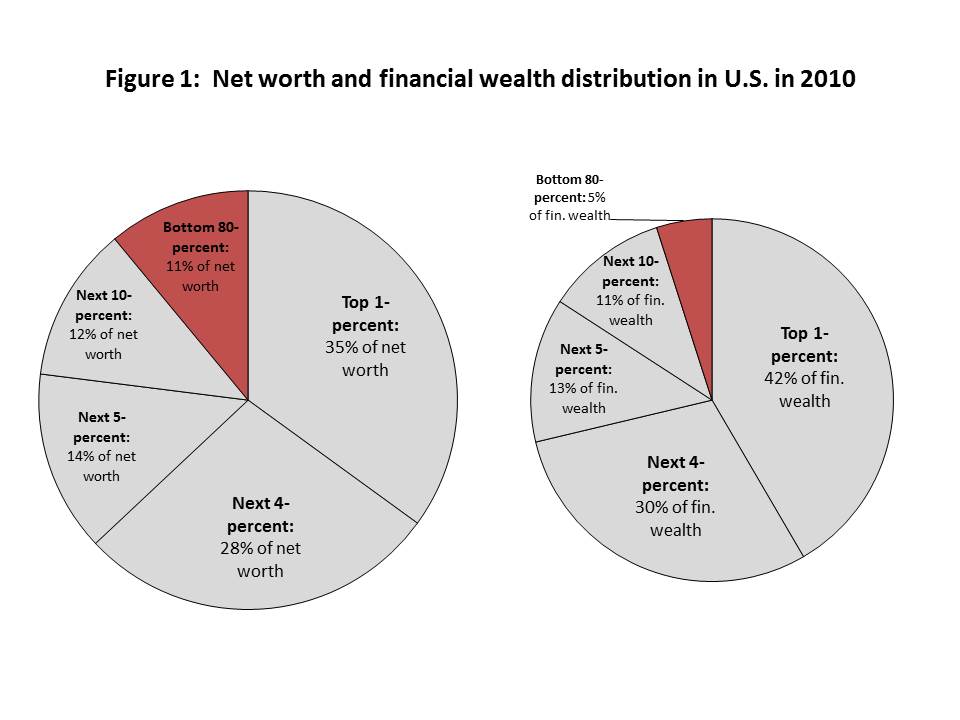
Beginning in 1983 economist Edward Wolff has tracked America’s net wealth and financial (non-home) wealth distributions. As Table 1 above and Figure1 below show, it is an increasingly bleak outlook for the majority of Americans.
Click image for larger view
1990 – Present: Globalization and World Superpower
The 1990’s will be compared to the prosperity of the 1920’s and the 1960’s. But as a whole is that what the data reveals? The AAHI was $32,558 in 1995 or about $49,000 in 2012 CPI dollars and America’s top 1-percent enjoyed another increase in the owned wealth of the nation at 38.5%. For six brief years (1994-2000) the economy saw rises in the national debt, the stock market, and the GDP while inflation plateaued and unemployment dropped below 5% because of the Dot-com Boom. Economist and civilians alike agree that the growth explosion was mostly a result of workplace computerization. But the good times would come to an end in 2001.
Map of the world wide web 1990-2000
A constant influx of immigrants seeking the American Dream, an American economy becoming one of the major players in a growing global economy, a false sense of security in the housing market, and numerous corporate scandals in the energy and finance sectors due to previous government deregulating, all contributed to the tipping-point by 2007. The AAHI in 2000 was at $40,418 or $53,900 in 2012 CPI dollars and the top 1-percent in America saw their portion in the nation’s wealth drop to 33.4% due to a sharp declining stock market worsened by the attacks of 9/11. There is another set of globalization dynamics that added to the plight of middle-America.
With the exodus of American jobs like cheaper electronics, fashion, shoes, and toys moving to developing nations, middle-Americans watched as their job and salary-leveraging also weakened with fewer lateral or upper employment positions. Then jobs in TV, auto, steel, and home-furnishing manufacturing followed. With those positions gone abroad, the American job-market went from high-paying management positions to simple service-industry low-paying positions which certainly need no college degree. This move marked the boom of trade-school certifications for a growing electronic blue-collar job-market.
Why Mexico is becoming a global manufacturing power – Bloomberg Businessweek article
The domino-effect of American digitization, the snowballing Internet, and high-speed networks spreading to all corners of the globe have combined to gorge the growing socio-economic gap wider and deeper. In 2007 the AAHI was $48,332 ($53,500 in 2012 CPI dollars) eaten-up by inflation and the cost-of-living. Meanwhile, the top 1-percent owned a steady 34.6% of the nation’s wealth. The lap of luxury doesn’t stop there. With the creation of a connected more global economy today, along with new multiple global opportunities and substantially lower-wages to foreign workers, it should come as no surprise what sector of the American population currently enjoys the fruits-of-foreign-labor.
The World’s 200 Richest People(s):
The most industrialized developed countries in the world by population-size are in Europe according to the 2013 United Nations Human Development Report. Of the top 10 nations with the highest Human Development Index (HDI), six of them are in Europe (see Report). One might infer from that list then that many of the world’s wealthiest people reside in those countries or at least in Europe. You would be wrong.
Of the 200 richest people in the world as of 2012, 61 of them (or 31%) are citizens of the United States. What is perhaps unexpected is where the second richest group of people call home. Of the next 139, 20 of them (or 10%) are Russian, ironically a former part of the old communist U.S.S.R. The next 26 richest people come from Germany (13) and Brazil (13) at 7% and 6.5% respectively. To see the world’s wealth and what portion of it is owned by the wealthiest 200, see the pie-chart below. For the most current world ranking of the world’s wealthiest as ranked by Bloomberg click here.
As the largest population of one of the most modern industrialized nations – currently 314 million and growing – the United States has the largest percentage of the population with the smallest percentage of the nation’s wealth. Since 1983, as seen in Wolff’s two Tables above, it has decreased every single year. To put this disparity succinctly, in terms of financial eggs-in-a-basket the top 1-percent own 35% of all privately held stock, 62.4% of all business equity, and 64.4% of financial securities in America. Is it any wonder why middle-American taxpayers were held for ransom in 2008 to bailout our own mega-banks and financial firms, mega-auto companies, and integral government-sponsored entities? The top 1 and 10-percent held the nation by the balls. Sit down, it get’s more alarming.
The top 10-percent own 81% to 94% of all American bonds, trust funds, stocks, and business equity, and nearly 80% of all commercial real estate. The real value of financial wealth is determined by control of income-producing assets; assets that can absorb recessions or devastating irreparable depressions. Therefore, it is reasonable to conclude that 10% of Americans own the United States. Talk about utter investment stupidity in placing the nation’s “eggs” in one or two baskets! There is no way to sugar-coat it. Perhaps Abraham Lincoln’s Gettysburg Address should be rewritten to reflect today’s socio-economic times: “Government of the 10-percent, by the 10-percent, for the 10-percent.”
Land of the Few, Home of the Lavish
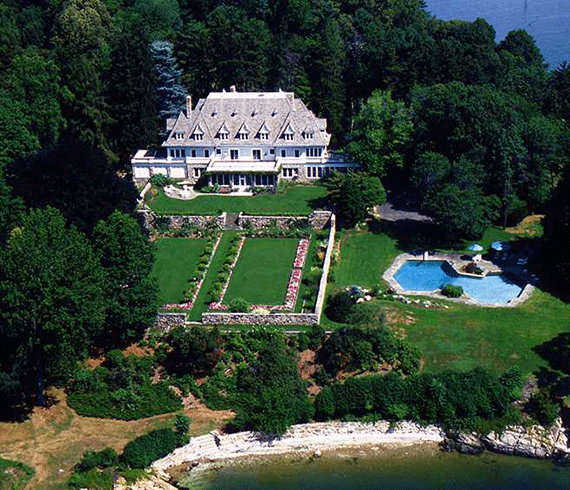
Listed at $190-million, Copper Beech Farm in Greenwich, Connecticut is the most expensive home in America. Built in 1896 and previously owned by the Greenway family of U.S. Steel with Andrew Carnegie as well as timber tycoon John Rudey, it has over 13,000 square feet on 50 waterfront acres with spectacular views of Long Island Sound. As a French Renaissance style home with 12 bedrooms, wine cellar, a 75-foot outdoor pool, a grass tennis court, a large formal arboretum, two greenhouses, and private apple orchard, accessible by a 1,800-foot private driveway. Oh, and the property includes two offshore islands.
Copper Beech – Greenwich, CT
Copper Beech Farm is simply one home of over 100 homes priced above $10-million. From 2005 through 2012 Greenwich, CT has been ranked as the best wealthiest place to live in the U.S., the “Biggest Earner” per household in the U.S., and #1 wealthiest residents per capita in the nation. Many of the residents are Wall Street hedge fund managers, writes Nina Munk of Vanity Faire Magazine, and “of the $1.2 trillion currently invested worldwide, approximately one-tenth, or $120-billion, is now managed out of Greenwich alone, according to Hedge Fund Research, Inc.” Munk also reports that four of the richest 400 Americans live in Greenwich and three of those are hedge fund managers. One Greenwich real-estate broker reported these four residents will drop five to eight-million dollars without a second thought. Some even a lot more.
“Almost As Big as the Taj Mahal – To judge by the number of swollen, over ambitious mansions rising from lots in Greenwich these days, you’d almost think we were back in the 1910’s and 20’s – except that this time round the lots are small, and the houses are almost on top of one another. “Years ago, wealthy houses were hidden in the rear of properties after long driveways…and no one ever built to the maximum allowable square footage,” remarked Diane Fox, long time director of Greenwich’s Planning and Zoning Department, in an e-mail to me. “Today all big houses want to be seen from the road.””
Munk’s article of Greenwich’s rich and lavish also mentions that one interior designer installed broadloom carpet at $74,000 for one bedroom, and drapes and curtains at $20,000 to $25,000 for one bedroom. You read it right, one bedroom.
Why is this level of wealth and excessive opulence worth mentioning?
Because today American legislation, political campaigns, and economic policies resemble little of what they did six decades ago. In 2010 the U.S. Supreme Court allowed American corporations, including those owned by the top 1 and 10-percent of the nation, the opportunity of donating vast financial resources for political candidates and their election campaigns; “resources” with millions of dollars beyond what any individual voters could organize. Remember, 80 to 90 percent of Americans hold or own just 4.7% of the nation’s financial wealth. The political phrase in the 1940’s and 50’s “one person, one vote” means today “one dollar, one vote.” That 2010 decision sets the stage for a class of super-wealthy political campaigners to push (as if a majority of individual voters) their one-dimensional political-economic interests: enhancing their profits and revenues.
A Communal America is Imperative
This four-part series has not been about political, economic, or social envy. It seems the bottom 99% or 90% are for the most part not jealous of America’s gazillionaires or their social contributions and hard-earned incomes. What this four-part series has been about though is political fairness, representation, and efficiency. As discussed in part two Productive Inequality, rent-seeking moves wages and wealth from the bottom and middle classes to the top 10 and 1-percent while distorting the “free market” in favor of some and to the detriment of most. More “efficient” policies of the market matter for a more equitable distribution of national wealth. Improper policies (e.g. of the last 32-years) lead to a less efficient economy and a growing divide between socio-economic classes.
Strength in lots of Einsteins!
It is a fairly simple overall concept. When our society is sufficiently (even abundantly) funded in infrastructure, education, research, and technology, these vital areas of a thriving economy offer hope and security to ordinary citizens. The majority of Americans, the bottom 90%, will actually SEE and experience for themselves what the U.S. Constitution, the Statue of Liberty, and all other symbols of democracy, equality and fairness are really made of… not just “promised” or rhetorically talked about on TV. Those principles would be available to a vast number in society in an efficient dynamic economy. Even the top 1-percent would benefit when the capabilities of so many quality workers and citizens are not wasted but fully utilized. It’s a concept of not just strength in numbers, but strength in well-educated, ingenious, motivated Einstein numbers! There is a huge difference between the two. The difference is not just inclusive, but very alien to exclusive.
In his superb book The Price of Inequality: How Today’s Divided Society Endangers Our Future, Nobel Prize winner in economics Joseph Stiglitz gives a superbly educated agenda on exactly how American government and her 314-million citizens can avoid falling into the same death-trap history’s great empires and their leaders fell into. If you would like to read an outline of his proposed extensive agenda, click here.
My own meek semi-educated ideas of how not to follow, for instance, the Roman Empire’s demise or the former Soviet Union’s, or the more recent countries of Egypt, Tunisia, and Syria… are this:
What is the reading on your/our Collective-Goodness-Gauge? What is the health of your/our common welfare, our passion for civic responsibility and the well-being of the persons near us?
These are NOT just social questions! More importantly they are political and economic questions too. As the French political philosopher Alexis de Tocqueville noticed about the nature of American society in 1835, freedom (or individualism) can be a tricky balancing act within democracy. Some “individualized” Americans independent of a majority often have the pragmatic realization that looking after the welfare of others is not only good for the soul, but is equally good for business and wealth. Stiglitz elaborates on this truth wonderfully:
“The top 1 percent have the best houses, the best educations, the best doctors, and the best lifestyles, but there is one thing that money doesn’t seem to have bought: an understanding that their fate is bound up with how the other 99 percent live. Throughout history, this has been something that the top 1 percent eventually do learn. Often, however, they learn it too late.”
…no matter class or status
The Roman Empire, Egypt, Tunisia, and Syria are just four examples to what Stiglitz refers. The former Soviet Union is an example of no individualism when no single “part” is allowed to reach its full brilliance and potential for the benefit of the whole; the other extreme. Both ends of the economic-socio-political spectrum REQUIRE resource investments and management from every single citizen. The stable “middle” if you will, has a steady balanced, efficient, fair, and equal flow of civic investment. Any one mechanism cannot efficiently coexist without the other efficient mechanisms. So…
If the United States wishes to return as one of the best symbols of freedom, liberty, democracy, and equality for all, then reaching that efficient balanced middle is an imperative collaborative, collective return to a well-managed, well-governed, wealth-balanced cause.
As I began teaching my middle school and high school students one day about the meaning and power of American citizenship, I realized that several of the basic conceptsof our government and how it functions the same from bottom to top seemed alien, even to the high schoolers. I had been taught these principles by my parents before I reached fifth grade. As a result, I guided my students back through a quick review and retaught some of these basic concepts and methods, all used successfully in our country (for the most part) for the last 230 plus years. But something else struck me as peculiar.
Many adults have the same naïvety as my students I stand before in my classroom. Of course the reasons for this naïvety should not be oversimplified. However, as is the case with any child on any given day, disabilities or not, they learn how to manipulate situations to meet what their natural, youthful self-centeredness desires. Recognizing this side of human nature, history shows that if this type of attitude and behavior is not modified at an early age, or at least addressed, then the families of the United States of America grow and nurture adults with firmly learned compounded narrow-mindedness; youthful egotistsin adult bodies if you will. Two integral components of a productive, proactive American adult is neglected: ownership and collaboration. How often do you hear these two simple terms in politics? More to the point, how often do you hear the terms and their real meaning during Presidential election years?
The making of American citizens
I am constantly baffled by American citizens whining incessantly about the current President and or his political party. In just about any public place or on any public forum or social media, you can always find jabs and derogatory remarks about one man, or one political ideal screwing up this country. Sadly, I hear this from my middle and high school students just as much! Where on earth are they hearing or being taught this annoying whining about one man or one ideal? I promise you this, not in my classroom and I hope not in any publicly funded classroom! By the way, American people are not ruled, governed, or enslaved by or to one man. It has thankfully been this way for yes, 235 something years. If the American public are proactive in their families, communities, states, and federal government — as has been given to them freely according to our Constitution — and proactive in self-ownership of their elected officials, then the reality is this: YOU are the one to whine about.
Also, if you find yourself in the “minority” of American laws and policies, then once again our system of government freely provides to you the methods of COLLABORATION within your community, state, and federal groups to begin your revolution of change. That is exactly how our nation’s forefathers constructed our government in the 1700’s and setting it up the same for you today.
Yet, do not be fooled into thinking that “revolutionary change” is in any way done by “THEM“. On the contrary, it is you who must be actively or proactively involved. You must sacrifice your own time and efforts to gain the change you seek. It is you who must learn to be a master of collaboration and diplomacy, not “them“. If you are truly convicted about your policies and ideology, then YOU become the next Thomas Jefferson, or Abraham Lincoln, or Martin Luther King, Jr. And I, as your equal, will first educate myself thoroughly on your dream of change, and if it coincides with my ideals, then perhaps together we can collaborate and take ownership of our social system as it was meant to be in the first place, and make those changes happen.
Good government starts in your own family
However, allow me to point out that before you can create a better America, or a better state or community, you must first have your own house and family in good, happy working order. The cliché “Those who can be trusted with the little things, can be trusted with the greater things” is never more true in this case. What is taught, nurtured, and matured in the home will either add to or subtract from our country. More precisely, if you were taught the basic principles of ownership, collaboration (teamwork), understanding, and tolerance for diversity, then your chances of making America better are profoundly excellent. If not, then you will find yourself always swimming upstream with no one to aid you, no matter how much you whine aloud.
President Obama, or the political party he affiliates himself, have never been the entire problem America faces today. Americans are sleeping in the very bed they have made for themselves. Whether it is a lack of principles, education, family values, collaboration, or whatever your slogan, take ownership America for your inactivity in local, state, and federal government, or your shortcomings of collaboration, understanding, and intolerance. But quit blaming “them”. Quit blaming one man. Pointing fingers at opposing political officials only demonstrates a severe lack of collaboration and ownership. Our governing officials, laws and policies are only a mirror of not only each American citizen’s voice, but equally our societal depth, from our own family right up to our federal officials.
President Obama, proudly take your seat. It isn’t your lack of leadership that has America in this predicament. It is each of us citizens, on every level; so…will the REAL America please standup, act collaboratively, and take ownership of your country’s good and bad. Our current economic and societal woes are “…for the people, BY the people“. It does not say by one man.
Before discussing this controversial topic, I strongly urge you to first read my blog Sexual & Gender Ambiguity. That blog is my personal foundation and experience on the subject of pro-life, abortion, and hate-crimes.
Those who know me really well know that I do not shy away from ANY topic of conversation…even if it is typically socially hyper-sensitive! But OH MY, I could NOT resist this excellent t-shirt and retort (borrowed from a friend of a friend)! I would add to the t-shirt, “If the fetus you save is gay, ethnically mixed, intersexed, and future Muslim President of the United States…will you still fight for its rights?” So…DIALOG anyone? Not heated bashing, but dialog please. Thank you.
I have zero expectation that anything I ever say will end someone’s belief in their God. Not my goal or purpose. That alone belongs to the individual. ~ Zoe
'Light thinks it travels faster than anything but it is wrong. No matter how fast light travels, it finds the darkness has always got there first, and is waiting for it' - Terry Pratchett

 I like to consider myself a calm, reasonable man with above-average capability for critical-thinking skills, appropriate de-escalation methods — from my years in the Psych/A&D and Crisis treatment field — college-degreed with additional 18-hours graduate studies, and a deep passionate fondness for history and social sciences resulting in 5-years of general and Special Ed public teaching. This is why I have a high respect and admiration for retired 4-star general and former Secretary of State Colin Powell. He is the consummate embodiment of stoic diplomacy coupled with first-hand experience in war and world conflict. What I admire most about the esteemed Colin Powell is how he conducted himself during America’s most polarized tumultuous times: Vietnam, the invasion of Kuwait & subsequent First Iraqi War, and 9/11. If those three “tests” were any indication and model of how to manage diplomacy, politicians, and the dynamics of crisis, then Powell passes with stellar excellence! Magna Cum Laude, if you will. Two of many of my favorite Colin Powell quotes…














 The Professor's Convatorium
